Inside Job is the 2010 Academy Award winner for Best Documentary, and takes a relatively objective apporach to analyzing the origin and consequences of the current global recession. Narrated by Matt Damon, the director uses pointed visual guides and graphs to explain the concepts of deregulation, systemic risk, etc. Augmented by interviews from economic insiders/pundits Paul Volcker and Eliot Spitzer, among other outsiders, Inside Job is and outstanding piece of work for bringing the drama of the recession to the limelight, and sparing no blame for the Wall-Streeters and corporate honchos alike, who allowed the excessive spending to spiral out of control into the mess our country is currently in, today.
Granted there's a lot of different people to blame for the recession, and more than just one factor, alone. Inside Job presents these factors as a slick outline, while sticking to the basic core factors of the housing bubble, credit bubble, and executive corruption. For some people who are not well-economically versed, a few things may go over their heads, I certainly had to work hard in order to keep my focus on the facts. Luckily, it's a topic that has strong relevance in today's political climate, and people should find that as incentive to watch (as long as they don't find the topic too depressing to stomach anymore). It is miles more comprehensive than Michael Moore's Capitalism: A Love Story, which I felt leeched more off of victims unemployment misery, making it a treatise of remorse, rather than diagnosis. Complex? Yes. Engaging? Definitely. Inside Job should satisfy anyone seeking answers to the cause of the crisis.
8/10
Peace,
- Jon
Showing posts with label documentary. Show all posts
Monday, June 6, 2011
Monday, April 11, 2011
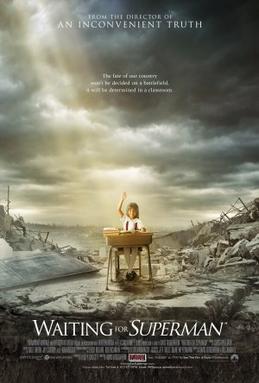
MOVIE REVIEW: Waiting for "Superman" (2010)
In America, most of us are critical about the educational system in some way, shape, or form. Some of us are lucky enough to have matured reasonably well from a good public school system. Others; like my parents, for example, were just lucky to have survived the more destitute examples. Waiting for "Superman" examines the gross miscarriages and failures of the American public school system through the eyes of multiple families. We see their experiences in trying to enroll their progeny into charter schools, and how the teachers unions, as well as the government put American schools into the quagmire they're in, today.
Speaking as one of the rare few that had the opportunity to attend a public school system whose town was centered around the prestige that came with it, it's amazing how much I took for granted what other public school systems could have been lacking for me, in comparison. At the same time, I was surprised and enlightened by a lot of the stories, ranging from the "lemon swap" system of changing teachers in school districts, the "tracking" system done to determine students futures, and efforts some families went through in order to make the winning lottery numbers of their charter school of choice. I only wish in retrospect I'd have gone to a charter school, simply because my personality has always been very school-oriented. Yet, I've spent a good deal of my time trying to also fight the frivolous bureaucracy that came along with it; from my parents protesting to my elementary school teacher it was unnecessary to put me on Ritalin, to convincing my high school guidance counselor that I was worthy enough for honors classes (and I sure as hell was!). School has always been an uphill battle for me. Yet, in spite of the detriments that came with the positive environment, I always made sure I managed to emerge victorious.
Now, for the film itself: this is a very pathos-oriented documentary. The facts that are presented are alarming, but I found myself, a lot of times questioning the validity of the sources. Granted further inquest showed much of them to be true, but isn't it rather silly for documentarians to avoid disclosing the source of their information when it is being presented in front of you? Also, I appreciated the elaboration of hypothetical solutions towards fixing the educational system from elite figures, like Bill Gates and Geoffrey Canada. But why didn't we get to hear about any from some actual teachers (besides those of the KIPP program) or other visionaries that are not in the upper-class elite, in order to get a more representative view? It goes without saying that the documentary wasn't exactly a perfect experience for me, but it does a good job of provoking one to think about these issues. Therein lies the real power of media to question our belief system, and do something about it.
8/10
Peace,
- Jon
Subscribe to:
Posts (Atom)