Showing posts with label western. Show all posts

Saturday, March 19, 2011

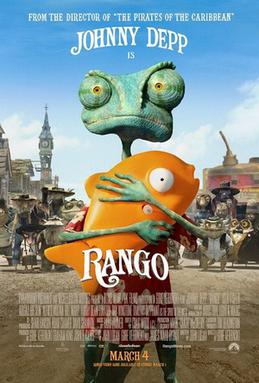
MOVIE REVIEW: Rango (2011)

My first reaction to seeing the poster and trailer for Rango was "Kermit the Frog's cracked-out chameleon cousin" (there's even a joke in the film about the relationship between amphibians and reptiles, go figure). The characters in Rango are so odd-looking, I'd expect the most overprotective of parents to be repulsed by their appearances in fear of how their kids might react. Nevertheless, Rango is a case of "never judge a book by it's cover", the story, spirit, and voice acting are what make this otherwise unorthodox, strikingly Tarantino-esque children's film very memorable.

A thespian chameleon with an identity crisis, Rango comes to adopt his name after his knack at improvisation lands him a new job as the sherrif of the town "Dirt". As he brings the town to believe that he's a tough, gun-slinger, he investigates a town water-shortage that's been brought on by a recent drought. Rango rounds up a posse, made up of the local town critters, and they go on an adventure that features some of the funniest action and adventure sequences I've seen in an animated film in years. Packed with homages from Apocalypse Now, to The Good, The Bad, and The Ugly, even the humor is enough to entertain adults as much as the kids.

Is there anything really that bad I can say about Rango? Well, I guess it can be a little cliche and abstract at times. It's also incredibly irreverant, so be prepared for some moments of weird humor that otherwise falls flat in comparison to most of the other wittier gags. If you're an adult seeing Rango thought, you're probably seeing it for the performances, and Johnny Depp, as usual, is fantastic. It was refreshing to see him play a socially awkward, occasionally wimpy-type since Sleepy Hollow, and the cartoon medium serves his performance wonderfully with Rango's un-humanly, wacky body language. Perhaps this may very well be my pick for Best Animated Film of The Year; not nearly as much of the emotional depth of last year's winner, Toy Story 3, but a lot of fun, for sure.

8/10

Peace,
- Jon

Saturday, February 26, 2011

MOVIE REVIEW: How the West Was Won (1962)

Normally, I'm not one to go leaping at the sight of a western on the movie shelf, but How the West Was Won attracted me for one reason on the box: "Cinerama". What is Cinerama, you may ask? It was, in my opinion, the IMAX of it's day: Basically, take three cameras shooting perpendicularly at 45-degree angles and stitch the three shots together on a tri-paneled, curved, screen - the result was an immersive experience that, according to the documentary on the DVD that I watched, helped bring TV-fixated post-war Americans back into the movie theatres, and gave birth to "Widescreen". You can read more on Cinerama, here.

So when I got around to watching How the West Was Won, I wasn't sure what to anticipate, in terms of presentation. But when presented on my 50" 16x9 LCD, I got something like this:


Now THAT'S wide! I don't think I'd seen actual letterbox on my TV in nearly eight years since we got a widescreen TV. I can only imagine what the film looked like in it's Cinerama heydey...

But onto the film itself - this is more or less so an episodic odyssey of a number of different vignettes somehow tying into the film's namesake of how American colonists carved a name out for themselves in the American west. It's a slice of classic Americana, done in true Hollywood style, and (if I may stand on my soapbox) complete with typical disregard to Native Americans by reducing them to stereotyped "savage" women and children-killers (as if white people didn't do any worse?). The stories are nice, but they're rather featherweight, lacking any realistic dramatic weight. In fact, the whole movie feels more like one of those elaborate travelogue films you go see at Disneyland, only this one at least tries to make an attempt at legitimizing it's Cinerama gimmick by going the distance with production value.

Aside from the story and acting, the overall production is very much impressive. Since I've already harped on the cinematography, I will say there are some nice action pieces, and the attention to detail as well as the attempt to at least drive somewhat of a cohesive narrative through the imagery is admittedly admirable. How the West Was Won is really more of an entertaining museum piece in my eyes, but it's a nice, visually splendid take on how Hollywood once used to run the show with panache.

7/10

Peace,
- Jon

Tuesday, February 15, 2011

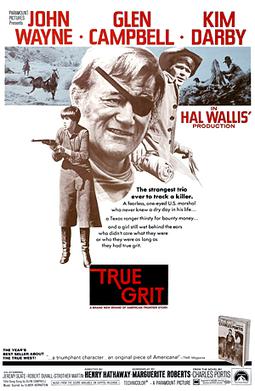
MOVIE REVIEW: True Grit (1969)

The original True Grit; it really doesn't deserve such a monniker, since it's technically a predecessing adaptation of the current Coen Brothers' version that's been getting rave reviews and as of this writing, received ten Academy Award nominations, including Best Picture. Quite a feat, seeing that these honors have overshadowed the two earned by the 1969 version, including John Wayne's only win for Best Actor. How does this version of True Grit hold up?

In the late 1800s American Old West, fourteen year-old Mattie Ross' father is gunned down by a petty thug named Tom Chaney. Seeking vengence, Ross gains the services of federal marshall Rooster Cogburn and Texas Ranger LaBoeuf to track him down. After a series of leads, and trip-ups, Ross and Cogburn's relationship evolves from uneasy reluctance to mutual respect. The acting from the leads serves the film just fine. John Wayne is in top form, even though he's playing his typical All-American Hero-type, again. Jeff Bridges, I felt really captured the literary essence and gruffness of Rooster Cogburn, so to say one is better than the other is merely subjective. The same goes for Kim Darby as Mattie Ross; while she looks a little mature (and unusually boyish! She was 21 at the time of filming) for the part, her energy is more than adequate, and serves her role well. A lot of True Grit's artistic and aesthetic qualities are definitely products of their time, but not without charm.

While it's hard to resist comparison with the 2010 version, I honestly did attempt to view True Grit with fresh eyes. To be perfectly frank, like many film versions of novel adaptations, True Grit feels very "Hollywood", in the most general sense of the word - I'm talking a sweeping film score that crescendos with bright fanfare during the action scenes, theatrically-influenced performances, grand set locales, and a nice, but remarkably out-of-place pop song during the opening credits - Is this necessarily a bad thing? No, in fact, I appreciate True Grit's vintage feel. As an adaptation though, it is dated; whereas, the Coen Brothers' gave True Grit a more realistic edge with respect to the novel's roots. I haven't read the novel, so it wouldn't be right for me to judge either version on those merits, so I will only say I enjoyed both films for what they were, even if I felt the quality of the 2010 version was more refined and appropriately crafted.

If there's one thing the 1969 version really has going for it, other than John Wayne's unique rendition of Rooster Cogburn, it's the cinematography. I was really taken aback by the beautiful panoramas of the Colorado vistas and plains that the film featured. The 2010 version is up for Best Cinematography this year, but the photography is much different; more artistic and actor-centric. Again, it's really apples and oranges in my opinion for both films. I know there's people out there who will always remain loyal to The Duke, but I like and I appreciate the existance of both versions without wanting to change a thing in either one.

8/10

Peace,
- Jon
Friday, January 21, 2011

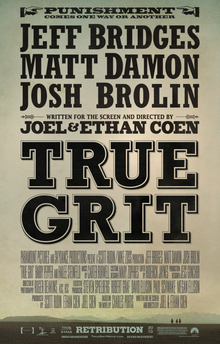
MOVIE REVIEW: True Grit (2010)

True Grit is a riveting love letter from the Coen Brothers to Golden Age-Hollywood westerns. Thought to have been a remake of the critically acclaimed John Wayne Oscar winner from 40 years earlier; from what I read apparently, the Coens went back to the original source material and based their screenplay more faithfully on the novel. Therefore, True Grit is not intentionally a "remake", nor do I think Jeff Bridges is playing off of John Wayne, either. This is a Coen Brothers imagining of a well-told story, which services their talents quite nicely.

In the American West of 1877, feisty fourteen year-old Mattie Ross enlists a rough U.S. Marshall named Rooster Cogburn to track down Tom Chaney, an employee of her father who murdered and robbed him in cold blood. Cogburn initailly refuses but agrees when Ross convinces him that his enduring quality of having "True Grit" is perfectly suitable for tracking Chaney down. They set off on an adventure that forms the real heart of the story, and transports the audience on a journey that wonderfully recaptures the rugged, minimalistic atmosphere of yesteryear western films blended with the Coen Brothers' penchant for vivid but engaging characters and surprisingly frequent but effective moments of deadpan and dark humor. For me, this was an unexpected and welcome touch from the Coens after the bland and aimless A Serious Man left a bad taste in my mouth.

Jeff Bridges is outstanding in his own rendition of Rooster Cogburn. Again, while I have yet to see the original, I believe it would be unfair to draw comparison. Plus, I've seen The Duke act, and I'm confident that his portrayal of Rooster Cogburn is in an entirely different league from Bridges' interpretation. Here, Cogburn is a crusty, swaggering anti-hero with a taste for whisky that exudes the same bumbling appeal that Bridges gave The Dude in The Big Lebowski. One wonders if Bridges' Cogburn was descended from Jack Sparrow, given his charming clumsiness but endless resourcefulness that gives him the drive to do his job better than anyone else. I consider Bridges portrayal of Cogburn to be one of my favorite characters of 2010, and I really hope he locks another Academy Award nomination for his role,

Supporting Bridges in the stellar acting department are Matt Damon as the stubborn Texas Ranger LaBoeuf, who's reluctant entanglement with Ross and Cogburn makes for some interesting character dynamics. Hailee Steinfeld makes her big break as Mattie Ross, and while I'm not quite sure she steals the show as much as Bridges did, her presence and performance are both strong for a young actress of her relatively ingenue status in Hollywood. The fast-talking, smart-as-a-whip young lady who manages to outwit her male "superiors" has become somewhat of a stock character since the days of Tatum O'Neil in Paper Moon. I don't believe this is Steinfeld's Academy Award-winning role, but I do think True Grit will open a lot of promising doors for her hopefully optimistic career.

True Grit may not live up to the expectations of overly-sentimental lovers of the original version, but the Coens have crafted their version with a careful hand. Thanks to the wonderfully charismatic cast and detailed production design, their vision is amplified to echelons that I would hope appeal to even the snobbiest of film critics. While it also isn't the most emotionally engrossing of films either, it does the western genre excellent justice, and that's something cinema has not seen very frequently in the new millenium.

9/10

Peace,
- Jon

Sunday, January 9, 2011

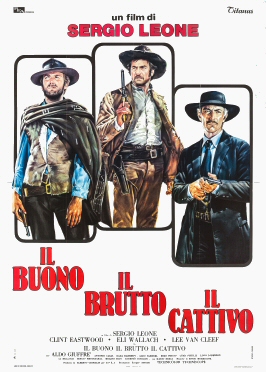
MOVIE REVIEW: The Good, the Bad, and the Ugly (1966)

The Good, the Bad, and the Ugly is probably my favorite western film. I know some chickenhawk out there is groaning over this clean-cut American boy appreciating a spaghetti western over some good 'ol John Wayne, but hey, this has Clint Eastwood! And spaghetti westerns were filmed with an appreciation for the American Old West. How much more American can you get? In case you were wondering, spaghetti westerns were Italian westerns filmed usually in the arid plains of southern Spain with international casts who were later dubbed into English or Italian. Back in the day, Sergio Leone was the master of them, and aside from the hysterical dubbing, they pulled off an uncanny resemblance to the American Southwest. And how can I forget the iconic theme song:


The film deals with three bandits of different personalities (personified by the title) on a rat race for treasure, two of the bandits (Clint Eastwood and Eli Wallach) frequently cross paths with one another and reluctantly join forces, because both know something about the location of the treasure that the other doesn't. The unspoken condition is they can't kill each other, or all is lost.

Along with this story, comes some sharp dialogue that may surprise you in it's cleverness as being quite ahead of it's time. It's easy to see from films like this where Quentin Tarantino and Robert Rodriguez derived all the written moxie from their own works. And yes, while at almost three hours in length, it's a considerable time investement, they seem to fly by like you wouldn't even realize it. It's easy to become so engrossed in the adventure aspect of the whole movie; it's films like these that really make westerns come off as art. I highly recommend anyone to check it out at least once in their lifetime.

10/10

Peace,
- Jon