Sunday, January 30, 2011
2011 Arab World Protests
Across North Africa and parts of the Middle East, the biggest story in recent news has been a series of mass-protests from the people of Tunisia, Algeria, Egypt, and several other countries of the de-facto Arab-speaking world. I've been keeping rather focused upon it, since it's been a really interesting scenario of how these events have unfolded. But lately, the attention has been drawn upon Egypt - the protests surrounding the forced expulsion of their president Hosni Mubarak. Some of these demonstrations across these countries have included demonstrations, riots, and even self-immolation; something I've been unfamiliar with since the Buddhist monk who did so in protest of the Vietnam war. I wanted to examine the case at issue with these protests, since it could present some interesting political changes across these countries.
Tunisia has apparently been the tipping point: What I've read from several sources was the people's general exasperation over problems with unemployment, corruption, and poverty became targeted upon their president, Zine El Abidine Ben Ali. Ben Ali has since fled Tunsia with his wife, and Interpol has a warrant out for their arrest. An interim president, Fouad Mebazaa, has been appointed according to the Tunisian constitution, but the protests continue to this day.
And then, there's Egypt. Under the similar circumstances, the people have been revolting under the 30-year regime of president Mubarak in reaction to his administration of repression and human rights violations. Mubarak has not stepped down as of this writing, but has revamped his administration and appointed a new Vice President. Needless to say, the people do not seem at all pleased.
I am in agreement with a lot of the news pundits who believe that this is an excellent opportunity for the governments of these countries to finally respond in full to the requests of their people, and allow a true democratic forum. Unfortunately, the response from those like Mubarak I feel has been less than adequate; cutting off Egypt's internet access, temporarily restricting cellphone use, and appointing new leaders who reputedly follow the same ideology as he does is doubtfully the step in the right direction. It's also an incredibly difficult situation for international relations, especially in the US's case, because Mubarak has been an important ally in combating the War on Terror. Still, I feel that regardless of whether or not one supports a greater cause, if a leader cannot govern their people and be expected to adhere to his or her people's expectations, then there is unquestionably a problem. The people should always come first in any circumstance, which is why these events are rather unnerving to me in the event that they represent the effects of large-scale government that has lost control and trust over it's subjects.
Revolutions are unpredictable, do we remember how quickly Iran's protests were silenced after Mamoud Ahmadinejad took power, once again? Who knows what will come out of the protests currently in effect now. At this point though, it seems the groundwork has been laid clear, at least for Egypt - Mubarak's presidency will cease to exist, or will never be the same. I hope whatever comes out of this, the people of these countries will finally get the representation they appear to have been fighting for. Whether the internet, or advances in community organization and journalism are responsible for these events, the people have found their voice, now it is being heard.
If you have family living in any of these countries, my thoughts are with you.
- Jon
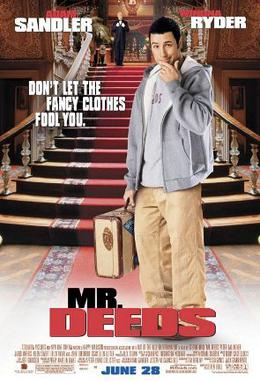
MOVIE REVIEW: Mr. Deeds (2002)
Every so often, there's an Adam Sandler movie that tends to fly under the radar for me. Mr. Deeds is one of them; a Sandler-ized remake of an old comedy from the 1940s of the same story. Needless to say, I'm sorry I missed it when it came out. Add to the fact it has a great soundtrack, even unexpectedly so, one of my favorite Dave Matthews Band songs "Where Are You Going" is featured rather prominently in the film. It's a nice unexpected touch, and for a Sandler comedy, I'd say Deeds is rather underrated.
An 82 year old billionaire kicks the bucket, and his investors scramble to find an heir to his $40 billion fortune. All they can find is a distant beneficiary; a pizza delivery boy from New Hampshire named Longfellow Deeds. Untainted by greed, Deeds enters his benefactor's home in New York City with naivetee and generousity, whilst being dogged by a sexy reporter who he ultimately falls in love with, played by Winona Ryder.
The cliches of Sandler comedies run abound in this one, with greedy villains, goofy stock characters, and that moment of broken trust which forces a temporary break-up with the love interest. Additionaly, Sandler's character has a special talent that figures in the end as his saving grace to a better life. These elements are of no surprise to me now, and make the story a bit predictable, but hey, it's still funny! And for once, Sandler isn't playing a complete jerk who serendipitously turns his life around, his character of Deeds is genuinely likeable and good-hearted. I wouldn't be surprised if this signaled a turnaround in his career when he started playing less clowns and more "characters". I can definitely say I'm glad I watched it, it was a nice refresher from the glut of dramas I'd been watching lately.
8/10
Peace,
- Jon
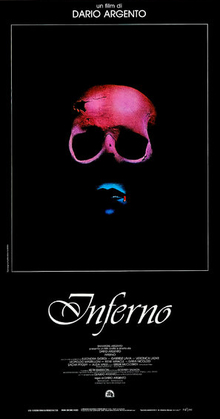
MOVIE REVIEW: Inferno (1980)
Continuing my little Dario Argento-fest has been much more of a mixed bag than I expected, not to say that I haven't been entertained, but most of the time they've raised my expectations a little high. From the stellar Tenebre to the disappointing Bird with the Crystal Plumage, I've now seen Inferno; Argento's second entry in his supernatural "Three Mothers Trilogy". I have no desire to see the third film right now, as by all accounts, I'm told it's terrible. Inferno however, shows he still has some of the stylistic edge he retained from the brilliance of Suspiria, but it lacks some momentum on its story.
Inferno starts off with a woman uncovering tomes regarding three evil witches known as The "Three Mothers", one of whom inhabits New York and threatens to terrorize the world upon her release. When the woman goes missing, her brother, a music student, goes searching for her around the city, and finds her apartment. Among her eerily-lit abode, he encounters the strange denizens, all connected in some way to some big secret, surrounding the woman's involvement with the Three Mothers.
Most of this sounds pretty compelling, and stylistically, it is. So much of the lighting and mood are almost exact duplicates of the amazing work Argento did in Suspiria. Inferno is supposed to be it's spiritual sequel, so it's no surprise it shares some stylistic qualities in common with its predecessor. The problem is, a lot of the story is bogged down by some plodding kill sequences that are meant to build suspense by showing the characters searching around for someone, or something, but up until the actual horrifically graphic murder, it's just boring. And these kind of sequences happen a lot, so there's a lot of unevenness with the plot. They didn't really bother my enjoyment of the movie, that much, and I will say Inferno is worth checking out if you're willing to maintain the patience.
7/10
Peace,
- Jon
Thursday, January 27, 2011
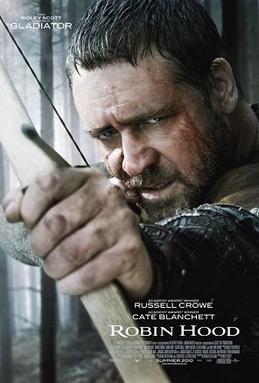
MOVIE REVIEW: Robin Hood (2010)
"Robin Hood" is one of my all-time favorite folktales; it's a guy's fairy tale, but without the magic. It's a story of good versus evil and a classic romance. It has an incredibly engaging cast of characters, and for a damsel-in-distress, Maid Marian is pretty atypical in regards to her resourcefulness, intelligence, and courage. Only Star Wars comes as close to "Robin Hood" in my heart as a "timeless tale". I've seen and read many versions, including Errol Flynn's brilliant Adventures of Robin Hood, Disney's goofy animated spin, Kevin Costner's campy Prince of Thieves, Mel Brooks' hilarious Men In Tights; and one day, I do need to get around to seeing Sean Connery and Audrey Hepburn's legendary Robin and Marian, which portrays the characters' autumn years. So, how does this revisionment of Robin Hood turn out? Ehh...
Ridley Scott is a misunderstood director, he's made a lot of great movies that were regarded as failures when they came out, but gradually became cult favorites. Perhaps Alien, Gladiator, and Black Hawk Down were the only instant successes of his that I can currently name off the top of my head. I will admit though, he can often bite a little more than he can chew when it comes down to style over substance. While I won't go into a synopsis, since I'm sure many of you are familiar with the story; it would appear with Robin Hood that Scott is trying to incorporate some of England's background history into the tale itself. Such blending fantasy and history is evident in one subplot where Eleanor of Aquitaine, disgusted with her son, King John (Richard is killed early on in the movie!), appeals to higher power to somehow dethrone him, or in another where William the Marshall tries to convince King John to sign the Magna Carta. My knowledge of Robin Hood's "historical" background is nebulous at best, since it was always a folktale for me, so I found this very jarring. Acting-wise, Crowe does fine, even if he's playing Maximus with a Scots-Irish accent. Cate Blanchett is refreshingly taut as Maid Marian, and everyone else services their roles fine.
This was a well-put together production, overall. However, I really had a lot of trouble letting go of the traditionalist angle of the story in favor of this revision. It didn't help that I found the storytelling to be surprisingly dry in light of Ridley Scott's visual flair and panache for action scenes. The action itself is cool, but scenes were sadly too far in-between, and the final battle is very over-the-top in an unnecessarily "Lord of the Rings" melodramatic fashion. This was easily one of my least favorite interpretations of "Robin Hood", but hey, at least it had some style to go along with it.
6/10
Peace,
- Jon
Tuesday, January 25, 2011
MOVIE REVIEW: The Bird with the Crystal Plumage (1970)
The Bird with the Crystal Plumage continues my enjoyable high off of Dario Argento films. This one, being his first is an interesting start, because for his debut film, Argento already displays the talents of his one-of-a-kind style. Unfortunately, as a thriller, I found it quite underwhelming in comparison with the intensity of Argento's later giallo and supernatural horror works.
Set in Rome (no surprise!), a young writer encounters a woman being brutally attacked in an avant-garde art gallery by a black-cloaked figure. Unwittingly involved as a witness to attempted murder, he decides to take matters into his own hands and solve the mystery on his own. A ton of red herrings ensues and some unsettling, but not exactly scary "kills" occur, until the killer is finally revealed. Rather than any reaction of shock, mine was disappointingly dulled to more of a rhetorical "oh, really?"
Perhaps it's unfair for me to judge the start of a healthy artistic career as inferior in comparison to later work, but as it stands, Bird didn't grip me as much as say Suspiria and Tenebre did. Both were relatively successful films later on in Argento's career, so I'm glad this one was enough of a hit for him that it allowed him to expand his creative wings. The relatively mild tension, somewhat aimless plot, and flimsy intimidation that the film exuded though, just happened to make it less of an enjoyable experience for me. It's a good thing some of Argento's later films fared much better.
5/10
Monday, January 24, 2011
MOVIE REVIEW: Carandiru (2003)
Films concerning human rights fascinate me, Carandiru happens to be one of those films. Set in a Brazilian prison of the same name during the early 1990s, a young doctor enters Carandiru in order to treat the predominatly male prisoners from a rampaging AIDS epidemic within the cells. Not only does he (and the audience) come to learn about some of his regular clients colorful backstories, but he discovers a whole culture within the thick, concrete walls of the prison. A culture where a skewed pecking order is established and the prisoners; murderers, drug dealers, hustlers, and pimps alike - some of whom even happen to be LGBT - all live within an unorthodox but tangible harmony. Only when conditions get worse, do things culminate in the horrific and real-life 1992 Carandiru massacre, where many of the prisoners met their end executed by riot police.
Carandiru is presented as an interesting neorealist slice of life. Although the actual massacre doesn't occur until the last 20 minutes of the film, we become as fascinated by the inmates as much as the doctor who is treating them does. Apparently, the director made a point to cast as few professional actors he could, and populates the cast with mostly non-actors - some of whom were allegedly former inmated of Carandiru, themselves. This gives the production a very authentic quality, and refreshingly unglamorous from the usual Hollywood or high-profile indie treatments. By the time the massacre hits, you understand how the prisoners felt as the violence hailed upon them; this is intentionally biased, because it is from the prisoners point of view, and it's done wonderfully.
With all it's splendor, Carandiru does actually happen to be quite long. At two hours and twenty-five minutes, it's a lot to take in at once. The stories can feel a little exhausting, but thankfully, the film moves at a brisk enough pace that length doesn't appear too much of an issue. Just as long as you can stomach the film's vividly visceral nature, the film is enjoyable enough.
8/10
Peace,
- Jon
Sunday, January 23, 2011
VIDEO GAME REVIEW: Heavy Rain (2010)
Heavy Rain is one of the most technically impressive and innovative video games I've ever played. Although I purchased it long before Sony enabled it for PlayStation Move capability. Once I acquired the Move, I decided to revisit this amazing achievement in interactive entertainment. Heavy Rain is proof that video games can transcend their reputation as ridiculously overpriced toys and function as a respectable art form. In this day and age, as the industry becomes stronger and stronger; to me, it's a sign that video games are achieving a greater admirability, and the production values as well as the creativity exuded by Heavy Rain certainly reflect that.
Created over a period of four years by the French digital animation/motion capture company Quantic Dream, Heavy Rain tells the story of Ethan Mars; an architect and single father, Norman Jayden; an FBI agent harboring a drug addiction, Madison Paige; an insomniac journalist, and Scott Shelby; a noble private eye. All four playable protagonists are searching for a serial killer known as the Origami Killer, who leaves the eponymous paper figurines with the corpses of his victims and who's main MO is abducting children. When Mars' son Shaun is kidnapped by the Origami Killer, the four individuals jump into action, each with their own, individual agenda to stop the Origami Killer.
The story is presented as a gripping noir mystery worthy of Hollywood, but the gameplay helps flesh things out and makes the plot more organic. You control your character from a third-person persective and interact with your environment searching for clues and making judgments based on your character's thoughts, which can be executed either in self-reflection or during conversation. Certain moments of action or high-intensity may require a "quick-time" event, where buttons need to be pushed in a certain order and time when they appear on screen. This makes for a very visceral gaming experience, because failure to complete these actions can result in a less-than desireable outcome for your character a la Mass Effect. I'll post a video of the demo here:
Playing with the standard PS3 wireless controller isn't too challenging, there's a slight learning curve with the "QT" events, but it's nothing too hard. Playing with the Move was pretty cool, but very frustrating without a tutorial. I still have yet to try the full game with the Move, which starts with the tutorial. I initially tried it while playing the Downloadable Content Level Heavy Rain Chronicles: Episode One - The Taxidermist, which lacked a tutorial, and I was embarassed at myself. Casual gamers like myself, therefore, may feel more comfortable using a wireless controller.
The attention to detail with the graphics is outstanding, Heavy Rain has a look that's similar to the Final Fantasy films by Square or Avatar, in that each of the characters are all motion captured, modeled, and voiced by the same actor. A few months ago, I played the game in front of a friend who was interested in seeing a demonstration, and he commented on how was impressed by the lack of "doll's-eye" in the facial models (especially in the loading screens when all you can see are the characters' faces). Although physical movements can still be a little stiff at times and the acting, a little shaky due to the accents from some of the foreign actors, the visuals are an incredible piece of work. They even made my video game-abhoring parents stop and stare at the screen in awe at times.
I love the music in Heavy Rain; it's a wonderful score that captures the bleak, somber mood of the game, along with the tension of the action scenes. Sometimes it has that quality of quiet unease like Bernard Herrmann did in Hitchcock's films, other times it has the stinging rush of energy like Danny Elfman. Either way, it's great. Each character has their own main theme: Ethan's is soft and somber, Norman's is dark and mysterious, Madison's is quiet and contemplative, Scott's is strong and forboding - heavy on bass. They all sound great, and I've even found myself studying along to the soundtrack due to its introspective nature.
To top it all off, the game has a myriad of endings that it makes a perfectly reasonable incentive to play through it again while encouraging experimentation. I've beaten the game already about four times and I never get tired of the story or seeing what happens strictly from trying new things. I consider Heavy Rain to be one of my all-time favorite video games and I strongly encourage any open-minded gamers with a PS3 and who enjoy a good adventure/mystery to check it out.
10/10
Peace,
- Jon
Subscribe to:
Posts (Atom)