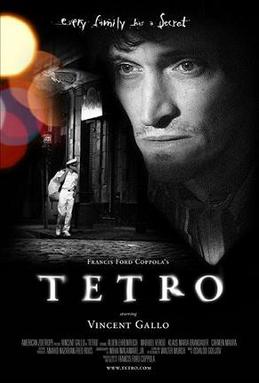
Having visited Argentina around the same time this film came out, I was delighted to have seen some familiar locales revisited in Tetro. What I didn't expect though, was that it happened to be a really good movie too. Perhaps the fact that it was directed by Francis Ford Coppola was a given; I hadn't seen any of his more current work, and I was pleased to see from Tetro that he is still in top form. With this film, however, his creativity hits new zeniths, and he manages to blend the visual storytelling from other metaphorically-bent directors, like Pedro Almodovar and Federico Fellini, while keeping intact his own brand of intense character study. Artsy as it may be, it's also a fine drama as well.
Bennie Tetrocini, a young military school dropout, travels to Buenos Aires, Argentina to reconnect with his estranged brother, Angelo. Upon entering the home he shares with him and his Spanish girlfriend, Miranda, Bennie discovers a withdrawn, morose soul, plagued with a broken leg, and an inconspicuous case of writer's block. Upon uncovering his unfinished work, Bennie decides to take charge of his life by reinventing himself as a writer, and basing his first work off of his brother's notes, much to Tetro's chargin. Bennie hopes that the final result will uncover the secrets behind his dysfunctional family, his relationship with Tetro, and finally give him closure and respect to the work he started.
Tetro is a really beautiful film to watch; filmed mostly in black-and-white, the cinematography and aesthetics are sublime and complement the grayscale scheme excellently. Some shots I almost consider picture-frame-worthy. Of course it goes without saying that the acting is very solid; most of the dialogue wavers between English and Spanish, and features two of my favorite actresses in Spanish cinema: Maribel Verdu, and Carmen Maura, both give fine performances and are a treat to watch. While the story is quite frankly, rather dark, it's not hard to invest in the story, as the audience will feel a sense of familiarity within the naivetee of Bennie's fish-out-of-water experience in La Boca. Coppola should really come back to doing mainstream film though, he is missed.
After coming off of a wonderful thought-provoking high from watching Apocalypse Now, I decided to check out a counterpart documentary shot on the set of the film by director Francis Ford Coppola's wife. The film is Hearts of Darkness: A Filmmaker's Apocalypse. Consisting of behind-the-scenes footage, interviews, audio recordings, and recollections narrated by Mrs. Coppola, this is a refreshingly different making-of documentary than the usual, back-patting, cinematic press-kits that are commonly seen on TV. Hearts of Darkness takes a view of life imitating art as Coppola's film begins to parallel his own struggle to even conceive it.
Beginning with Coppola and his production team travelling to the Philippines to shoot the film on location, mild disturbances occur when he is faced to re-cast Harvey Keitel with Martin Sheen as Willard, to dealing with Philippine army helecopter pilots abruptly abandoning the shoot in order to go fight local insurgencies. As the days drag on and shooting persists from initially scheduled three months to three years, more challenges begin to affect the troubled production from a typhoon destroying sets to an "uncooperative" Marlon Brando. It is even implied that the stress from these problems drove Coppola to attempting suicide.
Although not as revealing as I expected, with much of the documentary footage showing more work occuring rather than heated exchanges, Mrs. Coppola does give the audience a good idea through her candid narration (based on her production diary) of her viewpoint on what was going on. The film is also pretty short, for what I expect, nowadays out of a feature-length documentary, it's relatively ordinary nature reduces its status in this day and age as more of an elaborate DVD "extra-feature". Obviously, that is not the case, given the film's vintage. And yet, despite it's age, the information is incredibly valid. And chances are, you may not experience anything as brutally honest about the chaotic making-of this film than any other documentary. Hearts of Darkness, for what it's worth, is a commendable effort.
There are times where films have a magical ability to transcend mainstream attention, be culturally significant, and artistically superlative. Apocalypse Now is one of those films. Although I read Joseph Conrad's Heart of Darkness a year after I had seen Apocalypse Now, in high school, the book only made the parallels more distinct and profound (I also wrote a pretty damn good essay comparing the two, to boot!). Apocalypse Now is an excellent adaptation that makes only minor changes from the narrative, and the main themes expressed in 19th century Belgian-colonized Congo translate beautifully to American-occupied Vietnam. It has taken awhile to grow on me, but I consider Apocalypse Now, one of my all-time favorite films.
Additionally, I had a rare opportunity to repurchase Apocalypse Now on Blu-ray, because Best Buy was having it on sale for 60% off, and I also had been itching to watch the film in glorious high-definition. I was happy to find that I not only got a plethora of new extras, but also, director Francis Ford Coppola's recut, extended version Apocalypse Now Redux. Redux adds 30 additional minutes of footage to the film, and boasts a terrific digital remastering that has been applied across both cuts. If you have access to a Blu-ray player in your home, I highly encourage you to watch or buy Apocalypse Now on this medium. The remastering job is fantastic, and is a quintessential example of how Blu-ray can make a film look and sound "like-it-was-shot-yesterday". If you need further information, check out this comparison site that I found.
Set in the early days of American involvement in the Vietnam War, during the 1960s, Captain Willard, intoxicated by the horrors of war is put on a special assignment: to "terminate, with extreme prejudice" the enigmatic Colonel Kurtz. Kurtz apparently went AWOL and the US Army gets wind that he was comitting crimes against humanity, somewhere in the Cambodian jungles. Along the way, Willard and his crew make several stops at army checkpoints, witnessing the effects of the war upon people and combatants. Paranoia and fear also set in, but none of this compares to what Willard and his crew find in Kurtz's compound...
As a film Apocalypse Now is an amazing achievement: Plagued by a troublesome shoot for three years (the shooting was documented by director Coppola's wife in an excellent film Hearts of Darkness: A Filmmaker's Apocalypse, which I still need to check out), the film went on to win Best Picture at the Cannes Film Festival, according to various sources, and garnered 8 Academy Award nominations (losing Best Picture to the excellent, but incomparable Kramer vs. Kramer). Since I've discussed what I enjoy about the film's story at length, I'll discuss the style, which is incredible. Although the film is two-and-a-half hours long (and three for Redux), the editing and action have a great way of keeping your attention. The opening features a deep, electronically-processed bellowing of helecopter blades as they pass by the screen and drop napalm atop a jungle to the tune of The Doors's "The End". The film's atmosphere is rather grim and violent, but there's some light touches of humor here-and-there, and even from a USO show in one scene! Things really get scary once the crew reaches the Kurtz Compound; the score thumps monophonically and ominously like heartbeat as the crew approach the "heart" of the jungle, while being stared upon by Kurtz's white-paint-clad followers. The scenes that follow rival any horror film I've seen in recent years, and will ultimately leave you feeling drained and unnerved by the brilliance that has occured.
So how does Redux also compare? Well, despite being made with good intentions, I'm with the group that prefers the original cut. I have a love-hate-relationship with Redux, because the new scenes are very well-made, and expand some more upon the themes, but they are somewhat disruptive to the pace. Some of the scenes in question involve the crew stopping off at an encampment, where some Playboy bunnies from the USO tour happen to be. As they're having their "fun", their "innocence" is shattered when one of the troops carelessly knocks over a coffin containing a body; reminding them all of what war does to people. The other scene involves the crew stopping off at a French plantation, where the motives of colonization are raised and how the French expatriates perceive the war from their end. Willard smokes some opium with one of the women, and then they have sex. The next morning, it's back to hunting Kurtz. Again, while it's tricky for me, because the scenes complement the spirit of the film, wonderfully (especially the French woman Willard meets as the "white sepulchre", from the book). The film can really do without them, and as a whole, they feel out of place.
Whatever version you may be watching, Apocalypse Now is a masterpiece, and a work of art. The only thing that comes even reminiscently close to it, in my mind, and in recent years, is last year's Best Picture Academy Award-winner The Hurt Locker. With the idea that "war-is-hell", "war-is-a-drug", and that both films deal with a recent war at the time of their release, it shows how universal the themes of war remain in our consciousness and transcend eras. While they are both very different films, on the level of character study, I was surprised to have noticed these similarities. And yes, both left me feeling equally shaken about the horrors of war. But Apocalypse Now is a classic, and an epic. It will only become more appreciated and discussed as time goes by, and as a triumph in all aspects of cinema.
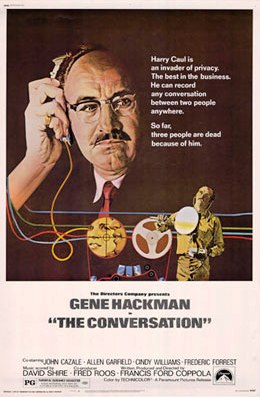
The Conversation is definately a product of it's time. Released around the time of the Watergate Scandal, it raises some serious ethical questions of the consequences of wiretapping (nowadays, this would be relevant as Dick Cheney's worst nightmare). This was directed by Francis Ford Coppola the same year he released The Godfather: Part II. Interestingly enough, he would go on to beat his own movie for Best Picture at Oscar time. But was it a deserved win? Definitely. The Conversation, while it has moments of great tension that represent the best of psychological thrillers, builds up to an unsatisfying conclusion.
Set in early 70s San Francisco, Gene Hackman plays a professional, self-employed "bugger" who is commissioned by a wealthy businessman to tap his lover (ha-ha...) while she is out, because he suspects she is having an affair. During recording of the titular conversation with "the other guy", Hackman picks up an incriminating message, and zealously sets out to find the meaning of it. Stylistically, this is one of the film's high points; the editing goes back-and-forth between the sound booth and repeated footage of the couple speaking as if we're envisioning exactly what is going on. To enhance this effect, eerie distortions are placed over the dialogue so the audience knows they're not actually watching "cinema", but a fabricated image based solely on the voices. As Hackman begins a descent into madness later on in the film, he starts having freakish visions of murder that almost belong in a horror film. The change in tone is jarring, but it works wonderfully.
Sadly, while thrills are plentiful in The Conversation, not so much can be said about the plot. Fans of Michael Haneke may enjoy this more than I did, as I wouldn't be surprised if this landmark film influenced his work. The film has a very nihlilistic theme running through it, but I felt as if I was set up for some sort of resolution for the main character and his antagonists. Unfortunately, there is none, and the ending feels extremely anticlimactic and abrupt. I literally sat there thinking "That was it?" And sometimes there's a purpose for those types of endings, but for me, it simply wasn't all that clear. All I can say is, it's a good thing the Academy chose The Godfather: Part II over this.