Being a relatively carefree freshman in high school, the Valerie Plame exposure scandal was something that understandably flew under my radar. Years later, I first became interested in the circumstances surrounding her illegal outing as a CIA agent after reading Scott McClellan stellar exposé What Happened: Inside the Bush White House and Washington's Culture of Deception, which dealt in detail the discovery of "Plamegate" from the perspective of President Bush's White House Press Secretary. Fair Game is a film based on a book by the same name by Plame, which re-tells the events leading up to and culminating in the scandal that cost Plame her job, privacy, and dignity. It's an incredible story for sure, and the film does adequate justice in outlining an interesting milestone in government corruption.
For those of you not immediately familiar with the story, Valerie Plame is (technically, was) a CIA operative who was frequently called upon for covert operations, in part, due to her background in international relations. After uncovering contradictory data relating to "yellowcake" and the lack of existing weapons of mass destruction in Iraq, to which her husband, former US Ambassador Joseph Wilson, writes an incriminating New York Times op-ed piece. The Bush Administration gets wind of this story, and under the supervision of advisors Karl Rove and Scooter Libby, expose Plame as a CIA operative, in an effort to discredit her husband's story. Seeking retribution, Wilson takes the battle to the mainstream media, but conflicts with his wife's interests, whose moral sense of duty restrains her from vocalizing her inner torment.
Fair Game is an interesting political drama, that as a drama in the most intrinsic sense, brings a very palpable mood to the story, thanks to the tight script and excellent performances by Naomi Watts and Sean Penn. Penn is actually a standout as Wilson, given Penn's own political leanings, he's practically born to play this role, as he channels his trademark rage against the Bush Administration in the form of his character. The beginning first act, consisting of Plame's investigation and day-in-day-out life as a spy is very expository; interesting, but not as gripping as the film's later acts when the scandal occurs and comes to a head. Director Doug Liman does inject some moments of melodrama towards the end, but they're not maudlin, and remind us that these real-life characters are human, and do have moments of weakness and fear that we may otherwise not realize. Otherwise, this is solid political storytelling, all around.
8/10
Peace,
- Jon
Showing posts with label drama. Show all posts
Wednesday, June 15, 2011
Wednesday, June 8, 2011
MOVIE REVIEW: 127 Hours (2010)
With 127 Hours, ladies and gentleman, I've officially seen all the Best Picture Nominees of 2010, and have seen all the Best Picture nominees for the...sixth year in a row. Sad? Or impressive? You be the judge (not that I really care all that much, haha). But in regards to the film, as simplistic (or repulsive) of a story from what you may already know, it packs an incredible dramatic punch. I never thought a film about a guy trapped in a canyon would be as thrilling as director Danny Boyle had made it out to be. While fascinating as it is, I doubt anyone who is faint of heart will find interest in it (especially the climax!). The more "disturbing" aspects of the film shouldn't really deter anyone, since it really is a one-of-a-kind work.
Based on a true story, young adventurer Aron Ralston is trekking the canyons of Utah, when a boulder sends him crashing down a deep trench, trapping his arm in the process. With no people in sight, one-half thermos of water, one camcorder, and one plier/knife. Aron realizes the gravity of his predicament. As he documents his state of mind on camera and begins to hallucinate under the stresses of pain and dehydration, the audience is treated to flashbacks of his life and vivid dream sequences that illustrate his frame of mind during the ordeal. Until eventually, he is forced to resort to drastic measures to survive, and escape...
This kind of film has "visceral" written all over it. I especially give Danny Boyle huge props for making such apt use of editing, sound, cinematography and music to express the myriad of thoughts going through Ralston's mind during the suffering. James Franco, as Ralston is excellent. I never really gave him much credit as an actor before, but the whole film is pretty much all about him, and he does an amazing job of conveying the inexplicable torture and despair that his character experiences. I wouldn't say that this is the kind of film anyone would really watch over and over again, but I admire the stellar work that has been done on this production. In the hands of someone else, it could easily have come off as too manufactured. The audience practically feels the same sense of desperation and ultimately relief after what Ralston goes through. Overall, Boyle has taken great pains to craft a story that stays with you, long after the credits roll.
9/10
Peace,
- Jon
Wednesday, April 27, 2011
MOVIE REVIEW: Memoirs of a Geisha (2005)
So I'm sure you're all wondering: "What the heck am I doing reviewing Memoirs of a Geisha?" especially when I haven't even read the book. I don't know if that's a bad move on my part, but the trailer drew me in. And once again, this film proved how much of a sucker for well-edited trailers I am. I wish I could say the same for the film itself, as I simply found it nowhere near half as exciting as the trailer had promised. The actual film itself covers an interesting piece of Japanese culture, but Memoirs is pretty much a protracted tale of style over substance.
In the early 20th century, young Chiyo is sent away by her poor farming family to be sold for slavery. She is taken in by the mistress of a geisha house. She makes repeated escape attempts in order to reunite and run away with her sister, but continually fails. One day, she captures the attention of an affluent man with an affinity for geishas. As she grows up, Chiyo is taken under the wing of geisha guru Mameha, and learns the way of the geisha. The adjustment period is particularly difficult for the beautiful, blue-eyed Chiyo, as men and the promise of freedom constantly tempt her.
I remember this film causing a huge controversy when it came out, due to the female leads being played by Chinese actresses. Whatever ire spurned between the Asian parties responsible is ridiculous to me, as the women in the film give great performances, in my opinion. The production design is very beautiful, and it shows from the three artistic design Oscars the film eventually garnered. For all the film's fine trimmings and the interesting view it gave behind geisha culture, it was extremely dull at times. The drama and pace seems to bounce around in a slipshod fashion; events come and go with very little establishment. I basically felt like I watched something that dragged on and on with loads of pretty pictures. The producers had a fine piece of work here, all they needed to do was find a competent screenwriter.
5/10
Peace,
- Jon
Friday, April 22, 2011
MOVIE REVIEW: Cat on a Hot Tin Roof (1958)
Ever since the passing of Dame Liz, it dawned on me that I had never actually seen any of her early work. My familiarity with her went only within the realm of her cheesy perfume commercials, the glut of news reports about her health, and The Flintstones. Since I had read Cat on a Hot Tin Roof, years ago in high school, it seemed perfectly fitting that this would be the one for me to check out. And hey...not only did Ms. Taylor happen to be a good actress, but BOY, was she gorgeous! She pretty much sizzles in this film alongside her equally talented co-star, Paul Newman. The color photography captures every nuance of soul through their piercing, lightly-colored eyes. But enough about them...
Brick Pollitt is an ex-football star-turned-alcoholic, who spends his spare time trying to drunkenly relive his glory days on the field by himself. Brick is married to Maggie - the "cat" - a sexually-frustrated sexpot who's become the black sheep of the family on account that she and Brick are childless. That problem is only one of many that encompasses the couple's turbulent relationship, and Maggie herself feels akin to the film's namesake, due to her undying loyalty to Brick and her lack of direction on "where to land" should she "fall off" the "roof". When Brick's father, Big Daddy's 65th birthday rolls around, and the family comes together once again, things begin to get really heated as the cracks in the Pollitt family begin to expose as well.
What was cool about stage-to-film adaptations in Golden Age Hollywood, is that many of the filmmakers took great strides not to mess too much with the original. Granted, there are some subtle changes and visual elaborations of off-screen activity, but for the most part, the film is pretty faithful to the play, from what I remember. The producers even managed to keep the supporting cast intact, which I thought was a nice touch. While I've already elaborated plenty on the acting, I will say for those of you who are wary towards watching old movies that this one is very dialogue-heavy. All of the action is pretty much confined to one set for the approximate hour-and-forty-minute runtime. However, I appreciate that kind of intimacy within a film. It's not very common, nowadays, but that's what makes Cat on a Hot Tin Roof stand out, in comparison to today's more flashier adaptations.
8/10
Peace,
- Jon
Wednesday, April 20, 2011
MOVIE REVIEW: The Paper Chase (1973)
From the moment I made it clear I wanted to go to law school, to the countless times my LSAT practice course instructor made references and quotes to this film, it became clear that seeing The Paper Chase was a mandatory rite of passage for law students and unavoidable out of my own curiosity. For many 1Ls, Paper Chase is the first thing to scare them as far as what to expect out of law school, based on it's candid, honest apporach to the classroom environment, grounded in the difficult and often humiliating Socratic Method. But since the film is technically a dramatic work, I took these things with a grain of salt, albeit, with some slight unease. Above all though, Paper Chase is a good movie.
James Hart is a clueless, first year law student at Harvard. Hailing from Minnesota, Hart is unprepared to deal with the rigors and intense studying at his fingertips. He also has to deal with vying for recognition from his professor; the stern, authoritarian Charles Kingsfield. Hart retreats from the stress rather easily by partying, or sleeping with the local school socialite, who has become the object of his affection and reluctant psychological distress receptacle. What changes things for Hart however, is when he realizes his new sweetheart is actually Kingsfield's daughter.
Films like these have a knack for keeping my interest, because they deal directly with events going on at large in my life and speak in a way that art so brilliantly does by creating characters that one instantly relates to. While Hart is somewhat of a man-child, he gradually grows into what the school expects of him, and his will to succeede is a very admirable quality. Likewise, Kingsfield, for all his thorns is an intriguing figure, in spite of his imposing presence. The pacing is very strong, and the film has a wicked sense of humor; whose strongest source is at the taut verbal sparring between Hart and Kingsfield. Perhaps, this is a fairly apt viewpoint of the Socratic Method in action. For a 1L-to-be like myself, Paper Chase didn't fully intimidate me, because that Harvard isn't representative of every law school in the US, but it gave me some good, emotional insight from an entertaining, fictional angle.
8/10
Peace,
- Jon
Thursday, April 14, 2011
MOVIE REVIEW: Animal Kingdom (2010)
Some films just come out of nowhere from different corners of the Earth, and you wonder what makes them so acclaimed. In this case, it was Academy Award nominee for Best Supporting Actress Jacki Weaver's intriguing performance as an Australian crime family matriarch in the film Animal Kingdom. As a stickler for great acting, I became even more intrigued by the trailer, marketing the film as a tense thriller, along with the blurbs that touted the film as "...an Australian Goodfellas". Unfortunately, whoever wrote that blurb may not have realized that Animal Kingdom is anything but either of the last two. Despite some promising setups, I must admit I was disappointed.
In Melbourne, 17 year-old '"J"'s mother is taken to the hospital, DOA from a drug overdose. Orphaned J seeks out his grandmother, affectionately nicknamed "Smurf". Smurf takes J into her home, where he realizes his extended family is really operating one of the most powerful crime rings in Australia. His hot-headed uncles represent various "trades" from car theft to drug dealing. When the heat goes up and J becomes embroilled in murder, involving a group of corrupt cops, he goes into a witness protection program. Forced to walk the line between his corrupt family and the ethically questionable authorities, J must act fast if he is to stay alive.
I can understand why many people find Animal Kingdom to be a great film, it's got wonderful characterizations and a story whose complexity perhaps rivals that of The Departed. It is unfortunate, however, in my opinion, that the direction for the film is staler than a week-old loaf of bread. While some may appreciate the long, drawn out segments of chasing or violent aftermath punctuated by the somber score, I found it to be incredibly dull and perfunctory. Even though the acting was more-or-less okay, so much of the dramatic moments were lacking in any sort of catharsis for me. In other words, I got the basic gist of the story, but the director's vision didn't meld well with my expectations and the result, overall, was a film that wasn't very out-of-the-ordinary in comparison to other crime tales. Oh well.
6/10
Peace,
- Jon
Wednesday, March 30, 2011
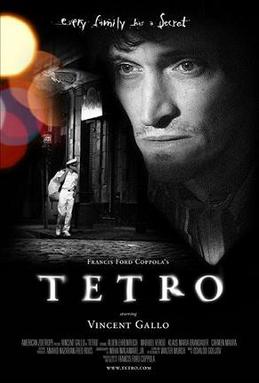
MOVIE REVIEW: Tetro (2009)
Having visited Argentina around the same time this film came out, I was delighted to have seen some familiar locales revisited in Tetro. What I didn't expect though, was that it happened to be a really good movie too. Perhaps the fact that it was directed by Francis Ford Coppola was a given; I hadn't seen any of his more current work, and I was pleased to see from Tetro that he is still in top form. With this film, however, his creativity hits new zeniths, and he manages to blend the visual storytelling from other metaphorically-bent directors, like Pedro Almodovar and Federico Fellini, while keeping intact his own brand of intense character study. Artsy as it may be, it's also a fine drama as well.
Bennie Tetrocini, a young military school dropout, travels to Buenos Aires, Argentina to reconnect with his estranged brother, Angelo. Upon entering the home he shares with him and his Spanish girlfriend, Miranda, Bennie discovers a withdrawn, morose soul, plagued with a broken leg, and an inconspicuous case of writer's block. Upon uncovering his unfinished work, Bennie decides to take charge of his life by reinventing himself as a writer, and basing his first work off of his brother's notes, much to Tetro's chargin. Bennie hopes that the final result will uncover the secrets behind his dysfunctional family, his relationship with Tetro, and finally give him closure and respect to the work he started.
Tetro is a really beautiful film to watch; filmed mostly in black-and-white, the cinematography and aesthetics are sublime and complement the grayscale scheme excellently. Some shots I almost consider picture-frame-worthy. Of course it goes without saying that the acting is very solid; most of the dialogue wavers between English and Spanish, and features two of my favorite actresses in Spanish cinema: Maribel Verdu, and Carmen Maura, both give fine performances and are a treat to watch. While the story is quite frankly, rather dark, it's not hard to invest in the story, as the audience will feel a sense of familiarity within the naivetee of Bennie's fish-out-of-water experience in La Boca. Coppola should really come back to doing mainstream film though, he is missed.
8/10
Peace,
- Jon
Tuesday, March 29, 2011
MOVIE REVIEW: Bonnie and Clyde (1967)
Crime stories always interest me, whether it's the inception of how their subjects fell into their dirty deeds, or just the lurid subject matter itself, it's always great material for entertaining storytelling. Bonnie and Clyde was something I'd been meaning to get around to for awhile. Notorious for it's level of violence back in the 60s, I can assure you, they weren't kidding! Bonnie and Clyde is probably the bloodiest, bullet-riddled film I've seen that's not a western (I can assure you, in my opinion, The Wild Bunch is more comfortably the Scarface of the 1960s, in terms of violence). What some may not know is, it also happens to be a pretty interesting character study, about it's two notorious subjects.
In the 1930s, Clyde Barrow meets Bonnie Parker, after she foils his attempt to steal her car. On a rash decision, Bonnie joins Clyde on several of his bank heists and becomes infatuated with her two new loves - Clyde, and a life of crime. What begins to complicate matters between them involves Clyde's obnoxious brother and his equally grating wife coming along for the ride. Despite the obvious pressures placed on their relationship, Bonnie and Clyde somehow manage to make a decent living out of becoming cultural icons of crime...for a while, anyway...
In a way, Bonnie and Clyde can almost be seen as a dysfunctional romance/drama with tommy guns. Faye Dunaway and Warren Beatty bring so much charisma and life to their characters that I became riveted the minute they stepped onto the screen. It's no wonder this film was so popular when it came out, the way director Arthur Penn glamorizes the gangster life almost makes the sins of crime seem like an idyllic fantasy in itself. At times, I couldn't decide though if I felt the pace of the film was too quick, because I didn't know if I was getting enough of a sense of character development in the film. However, the hedonistic tone, and the acting easily made me forgive this. And for a 60s film, the violence is fierce, with several sustained shootouts and enough bloodshed which probably paved the way for such graphic depictions like that of The Godfather. While Bonnie and Clyde is also a tragedy, it's an extremely riveting look that enthusiastically romanticizes the gangster life of the 1930s.
8/10
Peace,
-Jon
Saturday, March 26, 2011
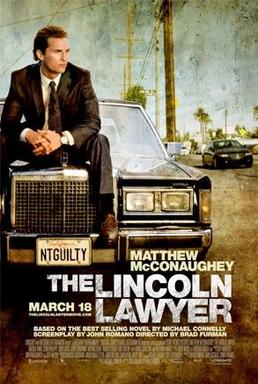
MOVIE REVIEW: The Lincoln Lawyer (2011)
Well, this was an interesting surprise. Matthew McConaughey in a movie that's not a romantic comedy, and where he doesn't play a half-baked meathead. Enter The Lincoln Lawyer, where McConaughey plays a shady criminal defense attorney, whose main clientele is the typical street scum of Los Angeles. Obviously a substantial departure from what he's done in the past, he carries the film with unquestionable charisma and the way he manifests his character. The actual movie itself...well...
Mickey Haller, a criminal defense attorney, conducts his consultations out of the back of his Lincoln sedan and away from the scrutiny of the office environment. One day, he is given the opportunity to defend the playboy son of a wealthy Beverly Hills mogul, who has been accused of murdering a prostitute in a bar. Through a series of contacts, Haller works his way into trying to manipulate the jury without having to let Roulet, his client, walk the green mile. That is, of course, when he realizes the linking role Roulet originally played in a case that didn't go so well for one of his earlier clients...
I really wanted to enjoy The Lincoln Lawyer, but honestly, I thought the way the director executed the project was...lackluster. The investigation versus the cross-examination courtroom scenes almost feel like they're coming from two completely different films. Needless to say, I was interested at the investigation aspect of the story, but when it came to the actual courtroom scenes, it just felt like perfunctory melodrama that ultimately drove the film into predictability. On the other hand, the acting was fine, and I think McConaughey actually managed to outshine the rest of the cast as the swaggering Haller, it's just a shame they couldn't tighten up the script and make the scenes with testimonials interesting. So yeah, I was a little disappointed with the way the film turned out, but at least I enjoyed the aspects that worked for me.
6/10
Peace,
- Jon
Sunday, March 6, 2011
MOVIE REVIEW: Last Tango in Paris (1972)
Somewhere online, I caught wind about the recent death of actress Maria Schneider to cancer. Her life story seemed pretty tumultuous, and much of it seemed to have precipitated from making her breakout film - Last Tango in Paris - an erotic drama that apparently was somewhat of a sleeper hit in the 70s, starring Marlon Brando, and featuring several steamy encounters between him and her that were responsible for the film's dubiously earned 'X'-rating (it's still NC-17, today). Curious on how the film has held up, as well as the story, I decided to check it out.
After the suicide of his wife, bereaved loner, Paul, wanders the streets of Paris in a nihilistic trance. One day, he encounters Jeanne, a nubile young woman who is engaged to be married to an equally-young filmmaker. When Jeanne runs into Paul again after trying to rent an apartment, the two set off a sexually charged affair that is marked by a no-strings-attached attitude, and a promise to remain anonymous towards one another, in order to receive what would appear to be emotional therapy from raw, human contact. Paul begins to complicate matters though, when he falls for Jeanne, and vice-versa.
Last Tango is a slow film, a characteristic that I've noticed of Bernardo Bertolucci. He's not a dynamic filmmaker when it comes to visuals, but very much so when it comes to characterizations. In which case, the acting here provided by Brando and Schneider is fantastic; there are spates of improvisation from Brando that are just downright funny at times, due to the spontaneity. But unfortunately, the film does go through some lulls and some may be disappointed to find out it's not as prurient like the poster may imply. While the few sex scenes are rather graphic, they're not portrayed in a sleazy, pornographic manner. I'd say it's still worth checking out, if you're interested in marginally artsy dramas. Just don't watch it too late so that you may give it your full attention.
7/10
Peace,
- Jon
Sunday, February 27, 2011
MOVIE REVIEW: Winter's Bone (2010)
Although, I'm now only two films short of having seen all of last year's Best Picture nominees before tomorrow's Academy Awards ceremony, it's rather lucky of me that my library was nice enough to send me a copy of Winter's Bone, today; this year's "indie-film-that-could" which has swept up a number of different festivals including the Grand Jury prize at the Sundance Film Festival. How admirable it is that this film has come so far to reach mainstream attention with the Oscars. While it's fairly ordinary storytelling, I sensed a quiet strength underneath it all, much like the performance conveyed by it's lead actress.
Based on a book by the same name, written a few years ago, Winter's Bone is about a poor Missouri family, living in the Ozarks, and cared for by 17 year-old Ree. When her drug-pushing father skips bail and disappears, Ree takes responsibility to go looking for him, lest she risk herself and her catatonic mother losing custody of Ree's younger siblings, due to her father putting up their assets as collateral. As Ree investigates into the matter further, she butts heads with the local townsfolk who seem bent on keeping Ree's father's disappearance a secret, and she seeks the protection and guidance of her uncle, Teardrop, to figure out what happened to him.
Independent films often have a knack for making incredible atmosphere, as a result of being a labor of love. Winter's Bone is no exception; this film is exudes the Ozarks through and through. The cinematography gives off beautiful vistas of the Missouri countryside, dotted with the gritty, destitute nature of Ree's neighborhood. The soundtrack is mostly folk music, but there's a wonderfully, melancholy score by Dickon Hinchliffe that reminds me of Gustavo Santaolalla's work in Brokeback Mountain.
And as for the performances, Jennifer Lawrence gives of a refreshingly mature, unforced, and natural portrayal of a headstrong teenager who is a victim of circumstance. She doesn't have many moments of high drama, but she lets Ree speak volumes through her subtle expressiveness. You don't need to know she's upset or angry just by seeing her go through the regular motions; the pain she often exudes is more restrained, more quiet, more internal. Although she may not win the big prize, she richly deserves her Oscar nomination. I'm well-aware her co-star, who plays her uncle is also up for Supporting Actor, and was also stellar, despite having a dearth of scenes.
As a neo-noir story, Winter's Bone is rather stylized, it demands a lot of focus towards the thick accents and the minimal editing. While there were some tense moments, I'd classify the film more as a drama or mystery, than a thriller. The ending may also leave some viewers questioned or unsatisfied by the outcome. Overall, while the story may not be as groundbreaking as others we've seen throughout last year, Winter's Bone manages to be entertaining, and providing enough dramatic weight without cloying for your attention.
7/10
Peace,
- Jon
Saturday, January 15, 2011
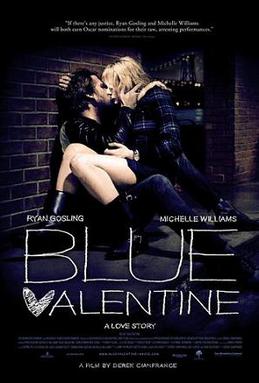
MOVIE REVIEW: Blue Valentine (2010)
Blue Valentine is the spiritual successor to (500) Days of Summer, but with a more somber tone. It is the cinematic complement to Eminem and Rihanna's "I Love the Way You Lie". In either case, it's the tragic story of the life and death of a marriage, told in a fragmented timeline as the audience is contrasted the courtship between the heated contentions leading towards breakup. All of this is directed with an apt hand by relative unknown Derek Cianfrance, who portrays the story under a more realistic and authentic light than similarly-themed, but glossier productions like Revolutionary Road. 50 percent of the film's strength comes from the tour-de-force performances by Ryan Gosling and Michelle Williams, who in my opinion, richly deserve Oscar nominations for their complex portrayals of the couple in turmoil.
The story is about a young couple living in rural northern Pennsylvania with their young daughter. Gosling is a high school dropout who paints homes for a living, but functions mainly as a stay-at-home dad, and it is implied he has an alcohol problem. Williams is his wife - a career-oriented nurse who quit medical school upon discovering she was pregnant with her daughter. All of this may sound familiar at first, because it is a story of countless relationships that we are cognizant of in our lives that are headed for disaster. What's different about Blue Valentine, however, is that it shows the breakdown in such an emotionally conflicting manner, that it's hearbreaking to watch. Despite the intoxication we may experience when falling in love, as time passes, there is still a chance for individuals to change personality: Gosling is the talented, directionless boy who never grew up, but truly finds happiness living simply with a wife and child. Williams is the ambitious girl who felt she threw away her lucrative educational potential for a life of stagnant domesticity. You desperately want these two to see a positive means to their ends and become content and civil. But like a devastating terminal illness (another subtle theme within the film), it just isn't meant to be.
Initially given a dubious NC-17 by the MPAA, but re-rated R after appeals, I wonder if the whole fuss was more a publicity stunt, rather than a controversy. The most graphic thing that occurs in this film are two brief sequences of strategically-obscured cunnilingus, and the rest of the film is standard R-rated fare. Case in point, I'm convinced by this film about the double-standard that the MPAA truly chastizes sex over violence, which demonstrates one of many unfortunate and absurd social maladies in America. Blue Valentine features a nice, folk-sy musical score from the band Grizzly Bear. The main characters' song, while pleasant out of context from the film, becomes incredibly melancholy after seeing the film itself.
9/10
Peace,
- Jon
Subscribe to:
Posts (Atom)