Saturday, February 12, 2011

Tiger Mothers - Can We Really Learn Something From Them?

Last week, I picked up in Newsweek and Time stories about a controversial book written by Chinese-American law professor Amy Chua: Battle Hymn of the Tiger Mother. What the book entails is a memoir from Chua of her childhood and subsequent parenting that stems from an age-old long tradition of raising children under alarmingly strict pretenses. But one wonders, is Tiger Mother a wake-up call to overly-permissive American parents? Or was the book's timing impeccable, due to our recent competition with China?

As an example of what "tiger mother" parenting entails (I will restrain from designating the parenting as "Chinese", since that would be biased) is described as such from Chua's Wall Street Journal article Why Chinese Mothers Are Superior. According to Chua, her daugters were not allowed to:


- attend a sleepover

- have a playdate

- be in a school play

- complain about not being in a school play

- watch TV or play computer games

- choose their own extracurricular activities

- get any grade less than an A

- not be the No. 1 student in every subject except gym and drama

- play any instrument other than the piano or violin

- not play the piano or violin


Shocking? Believe it or not, this style of parenting is unbelievably prevalent among many "Asian" cultures in the United States. I went to school in a very diverse neighborhood; the largest minority of students were of Asian descent in numerous ethnicities. I knew many students who confessed about their parents enforcing rules like these upon them; my cousin's Chinese-American ex-girlfriend, included. I was always perplexed by the strict nature of these parents; I grew up imposing the discipline on myself that these parents have been striving for, because my own parents taught me the value of self-worth and independence without penalizing me for failures or putting me under the gun to succede - these were treated as "life experiences". What concerns me is how do you prepare a child to accept failure when it occurs and "jump back on the horse"? Clearly, "tiger cubs" are being trained to be immune to failure, can such a thing really be possible?

In the more current interviews that I've read, Chua seems to have relaxed her parenting style a bit, she actually allows her daughters to go out more and even allowed her eldest to have a boyfriend. It's an interesting changeover from her condescension of American parents in what I see as hypocrisy and ethnic arrogance. I am in no position to give honest critique on parenting other than what I objectively see what other parents do; I have no kids of my own (yet) to actually dictate any sound advice. I don't see Chua as a bad person, and I think she's raised some fairly right-minded children. However, I do find her insights to be a little narrowminded.

I majored in psychology in college, one of the concepts I learned about was the "Nature vs. Nurture" debate: Does our environment shape who we are? Or is it how we are raised?" I strongly believe the former is a more influential aspect in our maturity as human beings into adults. Chua's concept of "tiger mothers" seems to undermine this idea, in my opinion. In a society where "tiger mothers" are training breed after breed of these überkids to pretty much rule the world, one wonders: where is the individuality that institutions like college and their admissions personnel are seeking? Where is the opportunity to actually learn and gain skills other than those prerequisite of "tiger mothers" outside of homework?

Given the economic competition the US is currently facing between China, of course some people may be alarmed at what the "tiger mother" parenting style may mean for future generations. I don't particularly see this as a huge concern because of my already-established position on ambition with individuality being key to personal success. Maybe Chua's style of parenting isn't particularly for everyone; I doubt all "tiger cubs" are really that predisposed to reaching success. Success comes from a variety of different factors; to prescribe it in the form of a laundry-list of parenting suggestions has questionable reliability.

Peace,
- Jon

EDIT (10:42 PM): I found a very interesting blog article from the perspective of an Asian-American that details why "tiger mother" parenting is imperfect and doesn't always correlate with success.

MOVIE REVIEW: Antichrist (2009)

Hello friends! Sorry it's been awhile, but between work and training for my new promotion to Pharmacy Technician, real life has been catching up to me a lot faster than usual (and leaving me with less leisure time). So I'll be doing my best to catch up on my writing this week, now that I have a little bit more "me" time.

About a week ago, I watched this offering from Lars Von Trier and the Criterion Collection: Antichrist, and I will say, despite two scenes of disturbing footage, the film is probably the most disgusting thing I've ever seen since Salò, or the 120 Days of Sodom. Antichrist is a harrowing tale about a bereaved couple who retreat to a getaway cabin in the woods after the accidental death of their son. What they begin to experience, aside from the wife's depression-induced hysterics, involve a series of unsettling visions that suggest the woods is haunted by some mysterious force that threatens to consume the unsuspecting couple in their wake.

Antichrist sounded interesting to me on paper, but the execution of it was not entirely to my liking. After a very provocative silent black-and-white opening with the son's death punctuated by graphic depictions of sexual intercourse, the film takes a slow, quiet course that's periodically interrupted by an argument, or a sex scene, and later on, disturbing acts of violence. It goes without saying, I was bored with the gaunt, nihilistic approach to drama. Charlotte Gainsbourg is just depressed and crazy throughout, and Willem Dafoe seems tired and stoic. For the film's first hour and thirty minutes, the only thing that kept my attention were the occasional vision, punctuated by dark, fantastical imagery.

But here's where things really hit the fan, by making me gag and sending my libido into an all-time low. The following description is rather graphic, so I'll let you highlight the rest. To save any of you from the trouble of enduring such disgusting scenes I'll just point out - there's a moment where Gainsbourg, enraged at her husband, takes a 2x4 to his testicles and masturbates him to the point where he ejaculates blood. She later on, severs her own clitoris with a pair of scissors at the apex of her madness. I swear, I am not making any of this up. For these scenes alone, the film has done really nothing to make an impression other than physically nauseate me with disturbing imagery. While I can't deny it's artistic qualities, the tepidness of the story and the violence are enough for me to deny a recommendation for Antichrist, unless you're into these kinds of works.

4/10

Peace,
- Jon

Monday, February 7, 2011

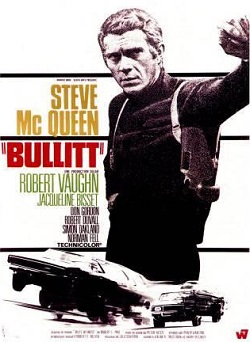
MOVIE REVIEW: Bullitt (1968)

In the 1960s, Steve McQueen was pretty much Hollywood's "It Boy" as we knew it. Or at least, that's what I learned after watching the extra features on the DVD for Bullitt. His legendary status, along with a reputation for being a hard-boiled action/thriller are what drew me to this film. Although Bullitt surprised me with an intense opening, it's pretty dated in terms of its pacing. And while the editing and action scenes are great, they're even outshone by its more recent successors like The French Connection (surprisingly, the two share the same producer).

Bullitt is about a San Francisco cop tailing a crime boss who murders a witness under the cop's supervision. Owing his sense of duty to the fallen gentleman, Bullitt decides to tail the murderer down on his own terms. While the dialogue in the film is minimal, it manages to be a bit more interesting to me than even some of the action. I'd estimate that at least 40% of the film is a parade of Steve McQueen mugging the camera and some really awesome muscle cars from the 60s...some of which, sadly, get trashed. But hey, at least they weren't in short supply over 40 years ago. This practice isn't really a bad thing, but it is quite ephemeral for a film.

Even if I found these drawbacks to be pretty surprising, the film still manages to be somewhat entertaining. I wasn't bored by the film or disinterested by the story, I guess I just expected a little more than what I had originally been led up to believe. Well, I guess that's what you'd expect from hype in any circumstance. I suggest if any of those criteria interest you, then give Bullitt a spin, just don't expect it to necessarily hold up to your general conventional knowledge of what an action/thriller should be.

7/10

Peace,
- Jon

Sunday, February 6, 2011

MOVIE REVIEW: The Fighter (2010)

Ah, the "boxing movie", such a tired subgenre in the annals of sports films. From Rocky to Cinderella Man and countless other iterations that continue to popularize the genre, it's sad to say, but we've seen it all before - lowlife who depends only on his athletic talent, needs to win the girl, has a drug addiction, family hates him, blah, blah, blah. The boxing genre is probably about as formulaic as the romantic comedy, when it comes to thematic elements. Then comes The Fighter, and despite seven Oscar nominations (at the time of this writing) and strong buzz about the performances of Christian Bale and Melissa Leo, the title and sight of boxing gloves automatically set my expectations low. However, The Fighter surprisingly does a little something different, and dare I say - break the mold by being a boxing movie that's not even really about boxing.

Based on a true story, set in 1990s Lowell, Mass. Mickey Ward is an up-and-coming boxer who trains with his aloof, crackheaded brother Dickie, and is managed by his overconfidant, high-strung mother Alice. After losing a long-shot match to a guy 20-pounds heavier than him, Mickey begins considering taking his career's matters into his own hands and away from his family. With the help of his girlfriend and stepfather, his career shows promise. But his family has enough problems of their own - Dickie is forced to confront his drug addiction and jail-time, and his mother is forced to confront the rationality of her own son's athletic abilities. This is where I defend my stance on The Fighter being a "lesser" boxing movie - the last quarter is dominated almost entirely by boxing, complete with the end fight-hanging-on-a-limb-but-wins cliche. However, the fights feature some great editing, and the cinematography impeccably duplicates the style of intense, oversaturated '90s pay-per-view live broadcast. The majority of the movie is rather a fine character study, a family drama, and even a pseudo coming-of-age adult tale.

Now here's what will become my global concern for the film - for all the work done towards the aesthetics and story for the film, I felt that Wahlberg and Bale had the lion's share of characterization, in terms of the screenplay. This makes me wonder if the Academy is playing politics again with Best Supporting Actress front-runner Melissa Leo, and Amy Adams. Leo's main competition - True Grit's Hailee Stanfield, is in my opinion, a decent actress with a well-written role. On the other hand, I felt that Leo's character wasn't very well-written, and basically played a Massachussetts-Housewife-From-New-Jersey (I swear, if it weren't for the accents, all the women in this movie could have been straight-up "Jersey Girl" stereotypes) whose main purpose was to yell, curse, scream, and give Wahlberg's character some conflict. Leo as an actress, is however, her character's saving grace - she brings great nuance and authenticity to a role that I feel is otherwise beneath her ability. The competition is a bit puzzling, given either of the "big-candidate" actresses have qualities in their characters that the other does not. The same problem with Leo goes for Adams, who was great in Doubt and Julie & Julia, but here...well...she's basically playing a "b*tch"...albeit one with a strong moral compass. Why Adams has an Oscar nomination for her role is beyond me; politics at it's best, I presume, but she's a great actress and does her role more than enough justice.

For it's few faults, The Fighter still manages to be a worthy adversary among this year's Best Picture nominees. The acting is great, Christian Bale and Mark Wahlberg included, who didn't receive my initial kudos, but appear here in top form. The directing is fantastic, and the editing serves the film for both the dramatic and action scenes. There may be a glut of boxing movies in America, and they probably won't go away anytime soon, but at least The Fighter manages to be something different, refreshing, and intriguing.

8/10

Peace,
- Jon

Friday, February 4, 2011

MOVIE REVIEW: The Apartment (1960)

The romantic comedy - such a bland genre in this day and age that was only captured so effortlessly in a handful of movies that I could name off the top of my head. The Apartment, is perhaps one of those: A quirky screwball comedy that happens to have a love story. Billy Wilder was one of the luminaries of the genre at the time, and his Apartment happened to win the Academy Award for Best Picture the year it debuted. Needless to say, while dated as a film, it still holds up as a story.

Lemmon is a New York office worker who owns an apartment that he lends out to co-workers who use it to have their dalliances with mistresses. On one particular occasion, he falls for the mistress of his boss. He is now forced to choose between her and his career, with some stressing events to follow. The setup is nothing we haven't seen before, 50 years later, but at least Wilder doesn't treat his audience like idiots and gives his characters more fleshed out personalities to work with. A little dramatic weight is added here-and-there to keep things grounded in reality, but still manage to work some screwball comedy magic.

Where the film's few faults lie happen to be from the format of the story itself, sometimes the seemingly episodic nature of events can seem a little disjointed - a relic of how storytelling back then was done for films. It's something I still need to get used to, but perhaps I just expect too much realism from my film, these days. I still believe The Apartment holds up, though. I was surprised how many times Jack Lemmon's antics had me laughing, I'd recommend it just for his performance alone.

8/10

Peace,
- Jon

MOVIE REVIEW: Russian Ark (2002)

Boasting the longest, unbroken take in the history of cinema at it's running length of 96 minutes. Russian Ark is an etherial, dreamlike film that explores the history of the beautiful country it represents while in the mold of a fairy tale. While intriguing as a film, many casual moviegoers may be hard-pressed to consider the slow-pace of the film entertainment. Still, it may be of interest to aficionados of history and Russian culture.

From a fade-from-black, a filmmaker describes awakening from a type of accident and finding himself conscious in 18th century Russia, he encounters a gentleman who takes him on a journey through time in Russian history as he encounters various important figures and people in a reflection of the time period. There's a certain air of sophistication and spontaneity from the acting that one can appreciate from the lack of edits as though it were live theatre or television being presented in front of your very eyes. It's a simple story, but nothing that leads to any extraordinary heights.

I think ultimately what might turn off a lot of people towards the film is it's main selling point of a 96-minute take itself. What makes for an interesting filmmaking experiment is sadly it's Achilles Heel, and perhaps a lesson of the practicality of film editing in the first place. Many times, there are long, drawn-out sequences of walking or waiting for action to occur. It certainly pulls off the dreamlike quality the film was trying to achieve, but even with all the visual splendor, it's easy for your mind to wander when these long stretches of nothing happen. I was nonethelss fascinated by it as a work of art, I just don't know if I'll be particularly seeing it again anytime soon.

7/10

Peace,
- Jon

Wednesday, February 2, 2011

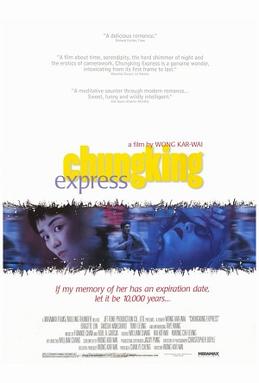
MOVIE REVIEW: Chungking Express (1994)

Another gem from the Criterion Collection that was endorsed heavily by director Quentin Tarantino finds it's way to the US again: from the whimsical mind of Wong Kar-Wai from Hong Kong. Chungking Express is a quirky romantic comedy with some mystery elements that's unlike anything you may be expecting from the genre. I certainly didn't, as I viewed this film too casually upon first glance and lost a lot of the film's meaning from my lack of engrossment. Upon second glance at the recommendation of a friend, I watched Express with a more discerning eye and found myself much more enlightened. Although, I still believe it's a film that cannot be taken lightly for its story.

Set in Hong Kong, 1994, Express weaves two stories of two different couples together with their own, unique personalities. The first act tells the tale of He Qiwu, a jilted cop with a penchant for canned pineapples bearing an expiration date of May 1st - the pending day he chooses to move on from his ex-love. He falls for a shady femme fatale who somehow re-ignites his fire, amidst her illicit dealings. "Act II" begins as He Qiwu brushes by Faye, a tomboyish snack bar attendant who falls for an unnamed cop (who is also going for the rebound). When the cop accidentally leaves his ex's set of keys to his apartment in Faye's possession, she makes an odd habit of breaking into his home and subtly improving his lifestyle. The hijinks that follow from these events are what make the heart of this film.

In an interview with Wong Kar-Wai on the DVD, he reveals his belief that his style is far more influenced by Eastern cinema than Western cinema, contrary to what he thinks many critics believe. I must've been greatly fooled, because watching Chungking Express, in spite of it's Asian setting and culture, something about the photography and script felt broadly European to me - the poetic dialogue, at times, bears shades of Truffaut. The camerawork has the enigmatic mood like that of Wim Wenders - I may sound crazy, but the stunning nature of these elements simply flooded me, involuntarily, with these memories. The editing is without a doubt Asian to the core - quick cuts and an almost improvised feel to much of the action. The film's style is definitely in a class of it's own.

Now, here's the tricky part: With such splendor, it often becomes a challenge to focus on the story. Hence why I'm convinced despite my botched first-viewing, that Chungking Express demands multiple viewings, if the story is too much to take in. This is not your average romatic comedy. Express conveys more in its images through the characters' inner feelings rather than through displayed emotions. Moreover, it's also rather cerebral. The dialogue and action need to be approached with an open mind, in order to reach those conclusions of rationalization that we the audience are always desperately seeking in our films. I will say though, I'm glad I gave Chungking Express another chance, and I was surprised at how much I missed from seeing it the first time around.

8/10

Peace,
- Jon