Perhaps it went by relatively unknown by my generation, but I Am Sam got some interesting attention when 2008's Tropic Thundercame out, on the topic of overly-melodramatic portrayals of individuals with mental handicaps. Curious about it's story, I checked it out and was pleased by the performances and overall charm exuded by the story. But not so much about some other things.
Sam Dawson is an barista at Starbucks, diagnosed with the intellectual capacity of a seven year-old, but is known for having a big heart and encyclopedic knowledge about The Beatles. He has somehow fathered a daughter with a woman who abandons her, immediatly after childbirth. Lucy Diamond Dawson grows into a healthy, intelligent child, but one who is unsure and insecure of the world around her, because of her parent's disability holding her confidence back. When Lucy is finally apprehended by Child Protection Services, Sam enlists the aid of icy lawyer Rita Harrison, who agrees to take his case pro bono as a step towards her own desire to be seen in a more charitable light. Rita teaches Sam the poise and strength required in a cruel society, Sam teaches Rita the value of love and family, both want to win back Lucy.
There are moments in I Am Sam that are truly touching, and it bothers me, because underneath some of the inexplicabilites of the film's logic, I sense there's a really good movie. For starters, there are a lot of holes in the backstory of Sean Penn's character; I felt incredibly questioned how Sam even happened to father a child. Given his intellectual capacity, Sam appears to be extraordinarily high functioning, but not at a level that appears realistic. How does he manage to hold down a job, an apartment, and adequately raise a child for six-to-seven years in his condition without some form of consistent assistance (and I'm not talking about Lucy's godmother, or Sam's equally handicapped friends)? These were areas of the film I felt were incredibly lacking in clarification, and bothered me throughout.
On the other hand, the care taken to realize other aspects of the film is phenomenal. Sean Penn is fantastic, engaging, and completely believable in his role. Same goes for Michelle Pfeiffer and Dakota Fanning, who plays his daughter. The cinematography and editing are also great, and really draw you into Sam's occasional states of confusion and overstimulation in a world he is still trying to understand, as much as his daughter is. While the film hits the right emotional notes, it's treatment of factual material seems like fantasy at best. I only wish the writers took some time to embellish on the grittier topics some more, so that the rest of us wondering about the origins of Sean Penn's character didn't feel left in the dust.
After coming off of a wonderful thought-provoking high from watching Apocalypse Now, I decided to check out a counterpart documentary shot on the set of the film by director Francis Ford Coppola's wife. The film is Hearts of Darkness: A Filmmaker's Apocalypse. Consisting of behind-the-scenes footage, interviews, audio recordings, and recollections narrated by Mrs. Coppola, this is a refreshingly different making-of documentary than the usual, back-patting, cinematic press-kits that are commonly seen on TV. Hearts of Darkness takes a view of life imitating art as Coppola's film begins to parallel his own struggle to even conceive it.
Beginning with Coppola and his production team travelling to the Philippines to shoot the film on location, mild disturbances occur when he is faced to re-cast Harvey Keitel with Martin Sheen as Willard, to dealing with Philippine army helecopter pilots abruptly abandoning the shoot in order to go fight local insurgencies. As the days drag on and shooting persists from initially scheduled three months to three years, more challenges begin to affect the troubled production from a typhoon destroying sets to an "uncooperative" Marlon Brando. It is even implied that the stress from these problems drove Coppola to attempting suicide.
Although not as revealing as I expected, with much of the documentary footage showing more work occuring rather than heated exchanges, Mrs. Coppola does give the audience a good idea through her candid narration (based on her production diary) of her viewpoint on what was going on. The film is also pretty short, for what I expect, nowadays out of a feature-length documentary, it's relatively ordinary nature reduces its status in this day and age as more of an elaborate DVD "extra-feature". Obviously, that is not the case, given the film's vintage. And yet, despite it's age, the information is incredibly valid. And chances are, you may not experience anything as brutally honest about the chaotic making-of this film than any other documentary. Hearts of Darkness, for what it's worth, is a commendable effort.
There are times where films have a magical ability to transcend mainstream attention, be culturally significant, and artistically superlative. Apocalypse Now is one of those films. Although I read Joseph Conrad's Heart of Darkness a year after I had seen Apocalypse Now, in high school, the book only made the parallels more distinct and profound (I also wrote a pretty damn good essay comparing the two, to boot!). Apocalypse Now is an excellent adaptation that makes only minor changes from the narrative, and the main themes expressed in 19th century Belgian-colonized Congo translate beautifully to American-occupied Vietnam. It has taken awhile to grow on me, but I consider Apocalypse Now, one of my all-time favorite films.
Additionally, I had a rare opportunity to repurchase Apocalypse Now on Blu-ray, because Best Buy was having it on sale for 60% off, and I also had been itching to watch the film in glorious high-definition. I was happy to find that I not only got a plethora of new extras, but also, director Francis Ford Coppola's recut, extended version Apocalypse Now Redux. Redux adds 30 additional minutes of footage to the film, and boasts a terrific digital remastering that has been applied across both cuts. If you have access to a Blu-ray player in your home, I highly encourage you to watch or buy Apocalypse Now on this medium. The remastering job is fantastic, and is a quintessential example of how Blu-ray can make a film look and sound "like-it-was-shot-yesterday". If you need further information, check out this comparison site that I found.
Set in the early days of American involvement in the Vietnam War, during the 1960s, Captain Willard, intoxicated by the horrors of war is put on a special assignment: to "terminate, with extreme prejudice" the enigmatic Colonel Kurtz. Kurtz apparently went AWOL and the US Army gets wind that he was comitting crimes against humanity, somewhere in the Cambodian jungles. Along the way, Willard and his crew make several stops at army checkpoints, witnessing the effects of the war upon people and combatants. Paranoia and fear also set in, but none of this compares to what Willard and his crew find in Kurtz's compound...
As a film Apocalypse Now is an amazing achievement: Plagued by a troublesome shoot for three years (the shooting was documented by director Coppola's wife in an excellent film Hearts of Darkness: A Filmmaker's Apocalypse, which I still need to check out), the film went on to win Best Picture at the Cannes Film Festival, according to various sources, and garnered 8 Academy Award nominations (losing Best Picture to the excellent, but incomparable Kramer vs. Kramer). Since I've discussed what I enjoy about the film's story at length, I'll discuss the style, which is incredible. Although the film is two-and-a-half hours long (and three for Redux), the editing and action have a great way of keeping your attention. The opening features a deep, electronically-processed bellowing of helecopter blades as they pass by the screen and drop napalm atop a jungle to the tune of The Doors's "The End". The film's atmosphere is rather grim and violent, but there's some light touches of humor here-and-there, and even from a USO show in one scene! Things really get scary once the crew reaches the Kurtz Compound; the score thumps monophonically and ominously like heartbeat as the crew approach the "heart" of the jungle, while being stared upon by Kurtz's white-paint-clad followers. The scenes that follow rival any horror film I've seen in recent years, and will ultimately leave you feeling drained and unnerved by the brilliance that has occured.
So how does Redux also compare? Well, despite being made with good intentions, I'm with the group that prefers the original cut. I have a love-hate-relationship with Redux, because the new scenes are very well-made, and expand some more upon the themes, but they are somewhat disruptive to the pace. Some of the scenes in question involve the crew stopping off at an encampment, where some Playboy bunnies from the USO tour happen to be. As they're having their "fun", their "innocence" is shattered when one of the troops carelessly knocks over a coffin containing a body; reminding them all of what war does to people. The other scene involves the crew stopping off at a French plantation, where the motives of colonization are raised and how the French expatriates perceive the war from their end. Willard smokes some opium with one of the women, and then they have sex. The next morning, it's back to hunting Kurtz. Again, while it's tricky for me, because the scenes complement the spirit of the film, wonderfully (especially the French woman Willard meets as the "white sepulchre", from the book). The film can really do without them, and as a whole, they feel out of place.
Whatever version you may be watching, Apocalypse Now is a masterpiece, and a work of art. The only thing that comes even reminiscently close to it, in my mind, and in recent years, is last year's Best Picture Academy Award-winner The Hurt Locker. With the idea that "war-is-hell", "war-is-a-drug", and that both films deal with a recent war at the time of their release, it shows how universal the themes of war remain in our consciousness and transcend eras. While they are both very different films, on the level of character study, I was surprised to have noticed these similarities. And yes, both left me feeling equally shaken about the horrors of war. But Apocalypse Now is a classic, and an epic. It will only become more appreciated and discussed as time goes by, and as a triumph in all aspects of cinema.
Ronin is a fairly obscure action flick from the 90s that is known for some punchy gunfights and car chases. I first became familiar with it when I saw an ad, way-back-when, of Robert De Niro taking a bazooka to a sedan on a country highway. If that wasn't awesome at eleven years old, then I don't know what was. The 'R' rating pretty much prevented me from seeing it, until thirteen years later. Yet, after being whetted on a diet of stronger action films of recent vintage, I was surprised that Ronin was actually more of a case of "looks-can-be-deceiving", and at the time, clever marketing campaign.
In France, an ex-IRA agent assembles a team of wayward spies and special agents from America and Europe to retreive an attractive metal briefcase from a group of shady Russians. The title Ronin comes from the Japanese word for a samurai who were orphaned by their master and mainly worked for money. This concept runs cleverly underneath the characterizations, and there's even some trademark deadpan humor to spare from co-screenwriter David Mamet (he apparently used a pseudonym in the credits, whatever).
In spite of the plentiful action that occurs in Ronin, I was surprised to notice while watching it that there's really not that much action that would traditionally qualify it for the genre, like say, Die Hard or Lethal Weapon. In fact, this comes off more as a heist/spy/thriller that has a few nice action pieces. The car chases are pretty good, but don't exactly hold a candle to James Bond. The cast is pretty good; De Niro and one of my favorite Francophone actors, Jean Reno, get a decent amount of screentime together. In fact, Ronin can be a little slow at times, with the possibility that some casual thrill-seekers may be left in the dust, due to the complex plot. I was just happy to have at least buried the hatchet by finally seeing it and being moderately entertained for two hours.
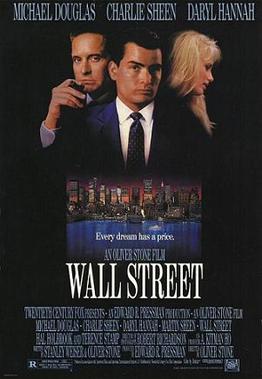
Oliver Stone is an immensely gifted filmmaker with a knack for culturally accurate storytelling and attention to detail that walks a fine line between esoteric and understandable. In the 80s, he was all over the place with politcally-charged films, Wall Street, while a thematic departure from his previous violent war-drama Platoon, offers an authentic insight into the glamorized excesses of yuppie 1980s culture and business warfare during the insider trading scandals that occured prior to the 1987 stock market crash.
Starting in 1985, Bud Fox is an enterprising stockbroker who miraculously manages to nab heavy-hitting corporate player Gordon Gekko. As he is drawn further into Gekko's world of style and shrewdness, Fox begins to realize the undercover work Gekko has him do in order to finalize buyouts may have illegal repercussions. His father, serving as the blue-collar voice of reason and honesty, and his trophy interior-decorator girlfriend also get caught within his newfound "greed-is-good" mentality. Fox finds himself at a crossroads whether to take the honest way out, or continue his jet-set lifestyle.
I first saw Wall Street when I was 11, and I hated it. Although it is rated 'R', I found it boring and self-indulgent. I guess my parents thought I'd be mature enough to understand the drama. Ten years later, a lot of the business lingo still flies over my head, but my tastes have evolved enough to appreciate the story, and the timelessness of the "greed-is-good" theme, in this day and age. Wall Street almost reminded me of a modern-day Great Gatsby; one of my favorite novels, not only because of how similar themes revolve around it, but because of the similar spiritual denoument the main characters ultimately face. With time, Wall Street will be regarded as one of those defining films of the decade it came out in.
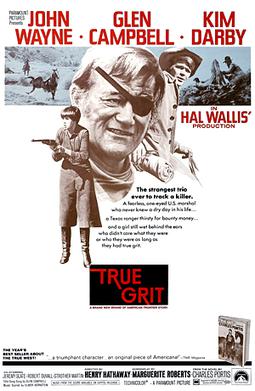
The original True Grit; it really doesn't deserve such a monniker, since it's technically a predecessing adaptation of the current Coen Brothers' version that's been getting rave reviews and as of this writing, received ten Academy Award nominations, including Best Picture. Quite a feat, seeing that these honors have overshadowed the two earned by the 1969 version, including John Wayne's only win for Best Actor. How does this version of True Grit hold up?
In the late 1800s American Old West, fourteen year-old Mattie Ross' father is gunned down by a petty thug named Tom Chaney. Seeking vengence, Ross gains the services of federal marshall Rooster Cogburn and Texas Ranger LaBoeuf to track him down. After a series of leads, and trip-ups, Ross and Cogburn's relationship evolves from uneasy reluctance to mutual respect. The acting from the leads serves the film just fine. John Wayne is in top form, even though he's playing his typical All-American Hero-type, again. Jeff Bridges, I felt really captured the literary essence and gruffness of Rooster Cogburn, so to say one is better than the other is merely subjective. The same goes for Kim Darby as Mattie Ross; while she looks a little mature (and unusually boyish! She was 21 at the time of filming) for the part, her energy is more than adequate, and serves her role well. A lot of True Grit's artistic and aesthetic qualities are definitely products of their time, but not without charm.
While it's hard to resist comparison with the 2010 version, I honestly did attempt to view True Grit with fresh eyes. To be perfectly frank, like many film versions of novel adaptations, True Grit feels very "Hollywood", in the most general sense of the word - I'm talking a sweeping film score that crescendos with bright fanfare during the action scenes, theatrically-influenced performances, grand set locales, and a nice, but remarkably out-of-place pop song during the opening credits - Is this necessarily a bad thing? No, in fact, I appreciate True Grit's vintage feel. As an adaptation though, it is dated; whereas, the Coen Brothers' gave True Grit a more realistic edge with respect to the novel's roots. I haven't read the novel, so it wouldn't be right for me to judge either version on those merits, so I will only say I enjoyed both films for what they were, even if I felt the quality of the 2010 version was more refined and appropriately crafted.
If there's one thing the 1969 version really has going for it, other than John Wayne's unique rendition of Rooster Cogburn, it's the cinematography. I was really taken aback by the beautiful panoramas of the Colorado vistas and plains that the film featured. The 2010 version is up for Best Cinematography this year, but the photography is much different; more artistic and actor-centric. Again, it's really apples and oranges in my opinion for both films. I know there's people out there who will always remain loyal to The Duke, but I like and I appreciate the existance of both versions without wanting to change a thing in either one.
Splice is a modern-day retelling of Frankenstein with refreshingly contemporary sci-fi trimmings. Not a straight-up horror film, as the previews may suggest, this is more of a cautionary drama that has some thrilling moments. There's even a hint of eroticism that crossed my mind as extremely bizarre. How this movie made it's way into the mainstream, I have no idea. Apparently, it was made in Canada. Go figure, at least someone across the border has more creativity in the film industry these days than Hollywood does. Splice is a monster parable that is something we've probably already seen once before, but I appreciated it's mature and edgy nods to modern science.
Clive and Elsa are a couple, who work for a big pharmaceutical company as geneticists, specialize in splicing animal DNA to create new organisms. When the company denies the Elsa's request to experiment with human DNA, she performs the work on her own and incognito. The result is "Dren", a part-human, part-chimera-like-creature. Her other ancestry is never explicitly established, but she bears special traits across different species that figure interestingly into the plot. Clive frequently butts heads with Elsa over her protective, motherly care over Dren, whom he generally regards as a mistake that must be vanquished. But as Dren matures, she begins to have thoughts of her own.
While the plot is not too complex, it glosses over it's cliches and predictability with some interesting themes. In today's world of genetic testing and stem-cell research, this is an interesting parable that probably explores the case against experimentation in a very extreme manner. The acting is very good and I felt the characterizations were very well-thought out. The very ending did bother me, quite a bit though. Did the pharmaceutical company really manage to cover up the consequences of Dren? How did Elsa manage to convince the company of her ultimate goal when she was already lambasted by the executive board? I wished that they didn't gloss these things over, but I guess they just had to ignore these things in order to set everyone up for a sequel. Regardless, I enjoyed the film, it isn't perfect, but it did the trick for what I was in the mood for.