Although, I'm now only two films short of having seen all of last year's Best Picture nominees before tomorrow's Academy Awards ceremony, it's rather lucky of me that my library was nice enough to send me a copy of Winter's Bone, today; this year's "indie-film-that-could" which has swept up a number of different festivals including the Grand Jury prize at the Sundance Film Festival. How admirable it is that this film has come so far to reach mainstream attention with the Oscars. While it's fairly ordinary storytelling, I sensed a quiet strength underneath it all, much like the performance conveyed by it's lead actress.
Based on a book by the same name, written a few years ago, Winter's Bone is about a poor Missouri family, living in the Ozarks, and cared for by 17 year-old Ree. When her drug-pushing father skips bail and disappears, Ree takes responsibility to go looking for him, lest she risk herself and her catatonic mother losing custody of Ree's younger siblings, due to her father putting up their assets as collateral. As Ree investigates into the matter further, she butts heads with the local townsfolk who seem bent on keeping Ree's father's disappearance a secret, and she seeks the protection and guidance of her uncle, Teardrop, to figure out what happened to him.
Independent films often have a knack for making incredible atmosphere, as a result of being a labor of love. Winter's Bone is no exception; this film is exudes the Ozarks through and through. The cinematography gives off beautiful vistas of the Missouri countryside, dotted with the gritty, destitute nature of Ree's neighborhood. The soundtrack is mostly folk music, but there's a wonderfully, melancholy score by Dickon Hinchliffe that reminds me of Gustavo Santaolalla's work in Brokeback Mountain.
And as for the performances, Jennifer Lawrence gives of a refreshingly mature, unforced, and natural portrayal of a headstrong teenager who is a victim of circumstance. She doesn't have many moments of high drama, but she lets Ree speak volumes through her subtle expressiveness. You don't need to know she's upset or angry just by seeing her go through the regular motions; the pain she often exudes is more restrained, more quiet, more internal. Although she may not win the big prize, she richly deserves her Oscar nomination. I'm well-aware her co-star, who plays her uncle is also up for Supporting Actor, and was also stellar, despite having a dearth of scenes.
As a neo-noir story, Winter's Bone is rather stylized, it demands a lot of focus towards the thick accents and the minimal editing. While there were some tense moments, I'd classify the film more as a drama or mystery, than a thriller. The ending may also leave some viewers questioned or unsatisfied by the outcome. Overall, while the story may not be as groundbreaking as others we've seen throughout last year, Winter's Bone manages to be entertaining, and providing enough dramatic weight without cloying for your attention.
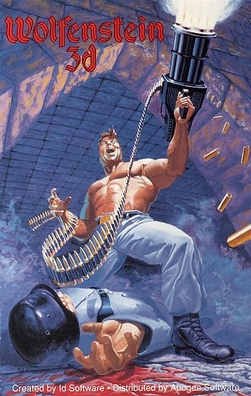
Wolfenstein 3D is commonly known around gamer circles as the grandfather of all first-person shooters. I happened to be well-aware of it's existence in my youth when my cousins acquired the shareware version on their Mac, and repetitively got in trouble with my parents for playing it, due to it's ultra-violence. Nearly 20 years later, in 2011, Wolf 3D is pretty tame by today's standards, but it still happens to be a lot of fun. Since it recently resurfaced on the PlayStation Network around the same time that the similarly-themed Inglourious Basterds was released, I found a copy online, and through running a program called "DosBox", managed to get this sick puppy gunning on Windows 7!
You play an American WWII POW, who has been captured by the Wermacht and brought to the infamous stronghold Castle Wolfenstein, in Nazi Germany. The object is to escape by blasting your way through legions of guards, enforcers, and even Der Führer, Hitler, himself! Along the way, you'll find secret areas containing treasure that you can collect for points, and ultimately extra lives, as you find your way to the exit and onto the next level. The game takes place over six episodes, each dealing with an evil plot that your protagonist must overthrow, in order to stop the Nazis.
Wolf 3D has definitely aged, there's no doubt about it. I'm sure many modern gamers may balk at the lack of "hand-holding" that this game does, in contrast to more recent digital fare. But I happen to appreciate it's simplicity; it's a great cooldown game after a long, hard day of dealing with the masses at work. Oh, what a guilty pleasure it is just to come home and plow down evil Nazis with a chaingun for about an hour or so, while my inner-Jew cackles at the morbid irony. The maze-like configuration of the levels can be frustrating at times, but it's surprisingly a great little way to exercise my spatial memory. While I wish there could be a little more variety to the game, it's fun enough to appreciate in it's simplicity.
Normally, I'm not one to go leaping at the sight of a western on the movie shelf, but How the West Was Wonattracted me for one reason on the box: "Cinerama". What is Cinerama, you may ask? It was, in my opinion, the IMAX of it's day: Basically, take three cameras shooting perpendicularly at 45-degree angles and stitch the three shots together on a tri-paneled, curved, screen - the result was an immersive experience that, according to the documentary on the DVD that I watched, helped bring TV-fixated post-war Americans back into the movie theatres, and gave birth to "Widescreen". You can read more on Cinerama, here.
So when I got around to watching How the West Was Won, I wasn't sure what to anticipate, in terms of presentation. But when presented on my 50" 16x9 LCD, I got something like this:
Now THAT'S wide! I don't think I'd seen actual letterbox on my TV in nearly eight years since we got a widescreen TV. I can only imagine what the film looked like in it's Cinerama heydey...
But onto the film itself - this is more or less so an episodic odyssey of a number of different vignettes somehow tying into the film's namesake of how American colonists carved a name out for themselves in the American west. It's a slice of classic Americana, done in true Hollywood style, and (if I may stand on my soapbox) complete with typical disregard to Native Americans by reducing them to stereotyped "savage" women and children-killers (as if white people didn't do any worse?). The stories are nice, but they're rather featherweight, lacking any realistic dramatic weight. In fact, the whole movie feels more like one of those elaborate travelogue films you go see at Disneyland, only this one at least tries to make an attempt at legitimizing it's Cinerama gimmick by going the distance with production value.
Aside from the story and acting, the overall production is very much impressive. Since I've already harped on the cinematography, I will say there are some nice action pieces, and the attention to detail as well as the attempt to at least drive somewhat of a cohesive narrative through the imagery is admittedly admirable. How the West Was Won is really more of an entertaining museum piece in my eyes, but it's a nice, visually splendid take on how Hollywood once used to run the show with panache.
Perhaps it went by relatively unknown by my generation, but I Am Sam got some interesting attention when 2008's Tropic Thundercame out, on the topic of overly-melodramatic portrayals of individuals with mental handicaps. Curious about it's story, I checked it out and was pleased by the performances and overall charm exuded by the story. But not so much about some other things.
Sam Dawson is an barista at Starbucks, diagnosed with the intellectual capacity of a seven year-old, but is known for having a big heart and encyclopedic knowledge about The Beatles. He has somehow fathered a daughter with a woman who abandons her, immediatly after childbirth. Lucy Diamond Dawson grows into a healthy, intelligent child, but one who is unsure and insecure of the world around her, because of her parent's disability holding her confidence back. When Lucy is finally apprehended by Child Protection Services, Sam enlists the aid of icy lawyer Rita Harrison, who agrees to take his case pro bono as a step towards her own desire to be seen in a more charitable light. Rita teaches Sam the poise and strength required in a cruel society, Sam teaches Rita the value of love and family, both want to win back Lucy.
There are moments in I Am Sam that are truly touching, and it bothers me, because underneath some of the inexplicabilites of the film's logic, I sense there's a really good movie. For starters, there are a lot of holes in the backstory of Sean Penn's character; I felt incredibly questioned how Sam even happened to father a child. Given his intellectual capacity, Sam appears to be extraordinarily high functioning, but not at a level that appears realistic. How does he manage to hold down a job, an apartment, and adequately raise a child for six-to-seven years in his condition without some form of consistent assistance (and I'm not talking about Lucy's godmother, or Sam's equally handicapped friends)? These were areas of the film I felt were incredibly lacking in clarification, and bothered me throughout.
On the other hand, the care taken to realize other aspects of the film is phenomenal. Sean Penn is fantastic, engaging, and completely believable in his role. Same goes for Michelle Pfeiffer and Dakota Fanning, who plays his daughter. The cinematography and editing are also great, and really draw you into Sam's occasional states of confusion and overstimulation in a world he is still trying to understand, as much as his daughter is. While the film hits the right emotional notes, it's treatment of factual material seems like fantasy at best. I only wish the writers took some time to embellish on the grittier topics some more, so that the rest of us wondering about the origins of Sean Penn's character didn't feel left in the dust.
After coming off of a wonderful thought-provoking high from watching Apocalypse Now, I decided to check out a counterpart documentary shot on the set of the film by director Francis Ford Coppola's wife. The film is Hearts of Darkness: A Filmmaker's Apocalypse. Consisting of behind-the-scenes footage, interviews, audio recordings, and recollections narrated by Mrs. Coppola, this is a refreshingly different making-of documentary than the usual, back-patting, cinematic press-kits that are commonly seen on TV. Hearts of Darkness takes a view of life imitating art as Coppola's film begins to parallel his own struggle to even conceive it.
Beginning with Coppola and his production team travelling to the Philippines to shoot the film on location, mild disturbances occur when he is faced to re-cast Harvey Keitel with Martin Sheen as Willard, to dealing with Philippine army helecopter pilots abruptly abandoning the shoot in order to go fight local insurgencies. As the days drag on and shooting persists from initially scheduled three months to three years, more challenges begin to affect the troubled production from a typhoon destroying sets to an "uncooperative" Marlon Brando. It is even implied that the stress from these problems drove Coppola to attempting suicide.
Although not as revealing as I expected, with much of the documentary footage showing more work occuring rather than heated exchanges, Mrs. Coppola does give the audience a good idea through her candid narration (based on her production diary) of her viewpoint on what was going on. The film is also pretty short, for what I expect, nowadays out of a feature-length documentary, it's relatively ordinary nature reduces its status in this day and age as more of an elaborate DVD "extra-feature". Obviously, that is not the case, given the film's vintage. And yet, despite it's age, the information is incredibly valid. And chances are, you may not experience anything as brutally honest about the chaotic making-of this film than any other documentary. Hearts of Darkness, for what it's worth, is a commendable effort.
There are times where films have a magical ability to transcend mainstream attention, be culturally significant, and artistically superlative. Apocalypse Now is one of those films. Although I read Joseph Conrad's Heart of Darkness a year after I had seen Apocalypse Now, in high school, the book only made the parallels more distinct and profound (I also wrote a pretty damn good essay comparing the two, to boot!). Apocalypse Now is an excellent adaptation that makes only minor changes from the narrative, and the main themes expressed in 19th century Belgian-colonized Congo translate beautifully to American-occupied Vietnam. It has taken awhile to grow on me, but I consider Apocalypse Now, one of my all-time favorite films.
Additionally, I had a rare opportunity to repurchase Apocalypse Now on Blu-ray, because Best Buy was having it on sale for 60% off, and I also had been itching to watch the film in glorious high-definition. I was happy to find that I not only got a plethora of new extras, but also, director Francis Ford Coppola's recut, extended version Apocalypse Now Redux. Redux adds 30 additional minutes of footage to the film, and boasts a terrific digital remastering that has been applied across both cuts. If you have access to a Blu-ray player in your home, I highly encourage you to watch or buy Apocalypse Now on this medium. The remastering job is fantastic, and is a quintessential example of how Blu-ray can make a film look and sound "like-it-was-shot-yesterday". If you need further information, check out this comparison site that I found.
Set in the early days of American involvement in the Vietnam War, during the 1960s, Captain Willard, intoxicated by the horrors of war is put on a special assignment: to "terminate, with extreme prejudice" the enigmatic Colonel Kurtz. Kurtz apparently went AWOL and the US Army gets wind that he was comitting crimes against humanity, somewhere in the Cambodian jungles. Along the way, Willard and his crew make several stops at army checkpoints, witnessing the effects of the war upon people and combatants. Paranoia and fear also set in, but none of this compares to what Willard and his crew find in Kurtz's compound...
As a film Apocalypse Now is an amazing achievement: Plagued by a troublesome shoot for three years (the shooting was documented by director Coppola's wife in an excellent film Hearts of Darkness: A Filmmaker's Apocalypse, which I still need to check out), the film went on to win Best Picture at the Cannes Film Festival, according to various sources, and garnered 8 Academy Award nominations (losing Best Picture to the excellent, but incomparable Kramer vs. Kramer). Since I've discussed what I enjoy about the film's story at length, I'll discuss the style, which is incredible. Although the film is two-and-a-half hours long (and three for Redux), the editing and action have a great way of keeping your attention. The opening features a deep, electronically-processed bellowing of helecopter blades as they pass by the screen and drop napalm atop a jungle to the tune of The Doors's "The End". The film's atmosphere is rather grim and violent, but there's some light touches of humor here-and-there, and even from a USO show in one scene! Things really get scary once the crew reaches the Kurtz Compound; the score thumps monophonically and ominously like heartbeat as the crew approach the "heart" of the jungle, while being stared upon by Kurtz's white-paint-clad followers. The scenes that follow rival any horror film I've seen in recent years, and will ultimately leave you feeling drained and unnerved by the brilliance that has occured.
So how does Redux also compare? Well, despite being made with good intentions, I'm with the group that prefers the original cut. I have a love-hate-relationship with Redux, because the new scenes are very well-made, and expand some more upon the themes, but they are somewhat disruptive to the pace. Some of the scenes in question involve the crew stopping off at an encampment, where some Playboy bunnies from the USO tour happen to be. As they're having their "fun", their "innocence" is shattered when one of the troops carelessly knocks over a coffin containing a body; reminding them all of what war does to people. The other scene involves the crew stopping off at a French plantation, where the motives of colonization are raised and how the French expatriates perceive the war from their end. Willard smokes some opium with one of the women, and then they have sex. The next morning, it's back to hunting Kurtz. Again, while it's tricky for me, because the scenes complement the spirit of the film, wonderfully (especially the French woman Willard meets as the "white sepulchre", from the book). The film can really do without them, and as a whole, they feel out of place.
Whatever version you may be watching, Apocalypse Now is a masterpiece, and a work of art. The only thing that comes even reminiscently close to it, in my mind, and in recent years, is last year's Best Picture Academy Award-winner The Hurt Locker. With the idea that "war-is-hell", "war-is-a-drug", and that both films deal with a recent war at the time of their release, it shows how universal the themes of war remain in our consciousness and transcend eras. While they are both very different films, on the level of character study, I was surprised to have noticed these similarities. And yes, both left me feeling equally shaken about the horrors of war. But Apocalypse Now is a classic, and an epic. It will only become more appreciated and discussed as time goes by, and as a triumph in all aspects of cinema.
Ronin is a fairly obscure action flick from the 90s that is known for some punchy gunfights and car chases. I first became familiar with it when I saw an ad, way-back-when, of Robert De Niro taking a bazooka to a sedan on a country highway. If that wasn't awesome at eleven years old, then I don't know what was. The 'R' rating pretty much prevented me from seeing it, until thirteen years later. Yet, after being whetted on a diet of stronger action films of recent vintage, I was surprised that Ronin was actually more of a case of "looks-can-be-deceiving", and at the time, clever marketing campaign.
In France, an ex-IRA agent assembles a team of wayward spies and special agents from America and Europe to retreive an attractive metal briefcase from a group of shady Russians. The title Ronin comes from the Japanese word for a samurai who were orphaned by their master and mainly worked for money. This concept runs cleverly underneath the characterizations, and there's even some trademark deadpan humor to spare from co-screenwriter David Mamet (he apparently used a pseudonym in the credits, whatever).
In spite of the plentiful action that occurs in Ronin, I was surprised to notice while watching it that there's really not that much action that would traditionally qualify it for the genre, like say, Die Hard or Lethal Weapon. In fact, this comes off more as a heist/spy/thriller that has a few nice action pieces. The car chases are pretty good, but don't exactly hold a candle to James Bond. The cast is pretty good; De Niro and one of my favorite Francophone actors, Jean Reno, get a decent amount of screentime together. In fact, Ronin can be a little slow at times, with the possibility that some casual thrill-seekers may be left in the dust, due to the complex plot. I was just happy to have at least buried the hatchet by finally seeing it and being moderately entertained for two hours.