Monday, March 7, 2011

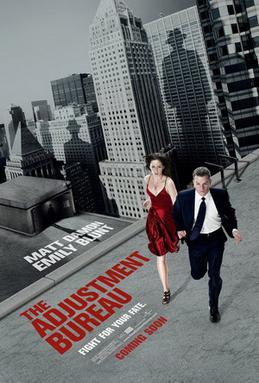
MOVIE REVIEW: The Adjustment Bureau (2011)

I hadn't originally planned on seeing The Adjustment Bureau, and the trailers, which made it seem like a poor rip-off of Damon's The Bourne Identity and The Matrix set my expectations low. But as I was watching it, I was somewhat surprised and slightly pleased by how the story actually defied the conventions and precedents established by it's own advertising campaign. What I got out of it, was a decent film that made a pretty serviceable adaptation of it's original source material.

Towards the end of the last decade, David Norris is a charismatic politician who is cooling his heels after abruptly losing the New York senate race. One night, he encounters a mysterious woman, Elise, whom he falls in love with, only to lose contact with her when a group of equally mysterious men known as "The Adjustment Bureau" reveal to him that they are in control of his and every human being's fated destiny on Earth, and that his own is not to be involved with Elise for the sake of losing any potential he has towards being contributory to humanity. Norris resists and a large-scale chase sets in between him and the team in a struggle over free will.

Adapting Dick's stories to film has often been a tricky task; especially when the works are short stories. The impression I get is that there's only so much plot to cover, you either fill in the blanks with artistic license or you pick a point in which to stop. Thankfully though, the screenwriters seemed relatively respectful towards this notion, so the pace and atmosphere of Adjustment Bureau are spot-on. It's a lot different than what many caper-film fans may be used to - there's only two scenes of violence, and most of the story is propelled by the romance angle. Could it have been more gripping? Probably. It's very good light entertainment at it's best. At my highest recommendation, it's something you can bring your significant other to and equally enjoy out of both genres it represents being relatively inobtrusive to one another.

7/10

Peace,
- Jon

Sunday, March 6, 2011

MOVIE REVIEW: Last Tango in Paris (1972)

Somewhere online, I caught wind about the recent death of actress Maria Schneider to cancer. Her life story seemed pretty tumultuous, and much of it seemed to have precipitated from making her breakout film - Last Tango in Paris - an erotic drama that apparently was somewhat of a sleeper hit in the 70s, starring Marlon Brando, and featuring several steamy encounters between him and her that were responsible for the film's dubiously earned 'X'-rating (it's still NC-17, today). Curious on how the film has held up, as well as the story, I decided to check it out.

After the suicide of his wife, bereaved loner, Paul, wanders the streets of Paris in a nihilistic trance. One day, he encounters Jeanne, a nubile young woman who is engaged to be married to an equally-young filmmaker. When Jeanne runs into Paul again after trying to rent an apartment, the two set off a sexually charged affair that is marked by a no-strings-attached attitude, and a promise to remain anonymous towards one another, in order to receive what would appear to be emotional therapy from raw, human contact. Paul begins to complicate matters though, when he falls for Jeanne, and vice-versa.

Last Tango is a slow film, a characteristic that I've noticed of Bernardo Bertolucci. He's not a dynamic filmmaker when it comes to visuals, but very much so when it comes to characterizations. In which case, the acting here provided by Brando and Schneider is fantastic; there are spates of improvisation from Brando that are just downright funny at times, due to the spontaneity. But unfortunately, the film does go through some lulls and some may be disappointed to find out it's not as prurient like the poster may imply. While the few sex scenes are rather graphic, they're not portrayed in a sleazy, pornographic manner. I'd say it's still worth checking out, if you're interested in marginally artsy dramas. Just don't watch it too late so that you may give it your full attention.

7/10

Peace,
- Jon

Wednesday, March 2, 2011

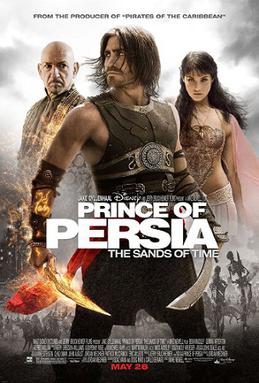
MOVIE REVIEW: Prince of Persia: The Sands of Time (2010)

Wow, this is Prince of Persia: The Sands of Time? Disney, what in God's name did you do to one of my favorite video games when I was a kid? Wouldn't it have been a lot interesting if you stuck with swordfighting turban-clad guards in spike-lined dungeons in order to rescue the princess? Why does Jake Gyllenhaal sound like he's dubbed with that pseudo-British accent? I wasn't really this clueless throughout the whole movie, but I did feel like it left a lot to be desired.

In ancient Persia, a street-smart youth hoodlum is taken under the wing of the king and raised as his own. As the Persian empire spreads and Princess Tamia, of a rival land is betrothed to the titular Prince Dastan, he becomes wrongfully accused of regicide by his people, when his father is mysteriously assassinated. Taking Tamia along with him, Dastan escapes into the desert, and comes across a magical dagger that can reverse time in the short term. The dagger is what becomes his and Tamia's sole dependant on restoring order to Persia, and the king's ursurper.

Jerry Bruckheimer knows how to produce good-looking films, but rarely ones with a comparable script. Prince of Persia is no exception; with almost entirely nothing but CGI, fight-scenes, and - albeit - very well-choreographed action sequences, I really felt like I was watching someone play a video game the whole time. Or, at least, one long video game movie sequence. The acting was fine, I can get over the casting, since let's face it - by our legal standards, Middle Easterners are de facto caucasian, and these are actors playing roles - end rant. But what the heck was up with Gyllenhaal's accent? It's unlike how he usually sounds, I wouldn't outright call it horrible, it was just...weird. Too bad I can't really find any good parody videos that I would put up.

Despite my criticisms, the action is rather stellar, and I enjoyed a lot of the stunts, sword-fights, and the cliche characters. I did tune out a lot to the overall film though, because the story was just so bland and ill-executed. It's a shame they didn't take the time to work on the script a little more, because whoever wrote dialogue for this was obviously just collecting his paycheck towards summer vacation.

6/10

Peace,
- Jon

Food for Thought: Spaghetti Al Pomodoro

Last year, on Mother's Day, I purchased the book Audrey Hepburn, An Elegant Spirit: A Son Remembers as a present for my mother. The book, written by Hepburn's son, is a touching memoir and account of his relationship with his mother, and even included some interesting recipes of hers. One that caught my eye, was Hepburn's recipe for Spaghetti Al Pomodoro (or pasta with tomato sauce, for all us Yanks). Not actually "her's" in the literal sense, but mentioned in the book as a traditional Italian recipe she adopted as her own.


The recipe interested me, because of the use of Roma tomatoes, and that it is quite similar to the rich pasta sauce my mother had perfected, notably with the use of carrots. Needless to say, I incorporated elements from both influences, and created something of my own. The one secret I'll keep is that I'll never mention what brand of Roma tomatoes I actually use, but they're fairly easy to find, and that's all I'll have to say.

- 2 large cans of peeled Roma tomatoes

- 2 celery stalks

- 2 carrots

- 1 small onion

(If you're short on prep time, you can substitute the last three ingredients for a cup or two of mirepoix. Wegmans sells it by the bag in the salad section; one bag will do the trick).

- 2 cloves of garlic

- A handful of mushrooms

- A bunch of fresh basil leaves

- Olive oil

- Red pepper flakes, black pepper, and a pinch of salt, to taste.

- 1 box of spaghetti (or your favorite kind of pasta)


Chop the onions, garlic, celery, carrots, and mushrooms. In a pot, coat the bottom with some olive oil and add the garlic and onions. sauté until the garlic starts to brown, and the onions caramelize and sizzle. Add the celery, carrots, and mushrooms, cook for several minutes. Add the tomatoes and a handful of the basil leaves, washed, and stir. Add the red and black pepper, and salt, along with a drizzle of olive oil. Stir well and let it simmer for 45 minutes. Turn off heat and let it sit for 15 minutes. Cook the pasta al dente, use some olive oil in the water to keep the pasta moist. Serve with the rest of the basil leaves, washed and cut, along with fresh parmesan.


It's safe to say that this dish was a success at my little Oscar Nite bash at my house. A bit indifferent about The King's Speech winning Best Picture, but it's a good movie for sure. I may not be Italian, but it's my personal opinion that the dish tastes closest to the salsa di pomodoro I've had in several local, authentic Italian restaurants in central New Jersey. Anyway, this is a great dish - it's cheap, healthy, and can be made in at least an hour. The sauce even stays fresh for quite a while. I should make more, as I'll probably be craving it, soon...

Also, I really should read up on what's been going on, over in Wisconsin with the unions, but a lot has been going on in my life, lately. Hopefully, I'll get a chance when life slows down a notch. ;-)

Mangia!
- Jon

Sunday, February 27, 2011

MOVIE REVIEW: Winter's Bone (2010)

Although, I'm now only two films short of having seen all of last year's Best Picture nominees before tomorrow's Academy Awards ceremony, it's rather lucky of me that my library was nice enough to send me a copy of Winter's Bone, today; this year's "indie-film-that-could" which has swept up a number of different festivals including the Grand Jury prize at the Sundance Film Festival. How admirable it is that this film has come so far to reach mainstream attention with the Oscars. While it's fairly ordinary storytelling, I sensed a quiet strength underneath it all, much like the performance conveyed by it's lead actress.

Based on a book by the same name, written a few years ago, Winter's Bone is about a poor Missouri family, living in the Ozarks, and cared for by 17 year-old Ree. When her drug-pushing father skips bail and disappears, Ree takes responsibility to go looking for him, lest she risk herself and her catatonic mother losing custody of Ree's younger siblings, due to her father putting up their assets as collateral. As Ree investigates into the matter further, she butts heads with the local townsfolk who seem bent on keeping Ree's father's disappearance a secret, and she seeks the protection and guidance of her uncle, Teardrop, to figure out what happened to him.

Independent films often have a knack for making incredible atmosphere, as a result of being a labor of love. Winter's Bone is no exception; this film is exudes the Ozarks through and through. The cinematography gives off beautiful vistas of the Missouri countryside, dotted with the gritty, destitute nature of Ree's neighborhood. The soundtrack is mostly folk music, but there's a wonderfully, melancholy score by Dickon Hinchliffe that reminds me of Gustavo Santaolalla's work in Brokeback Mountain.


And as for the performances, Jennifer Lawrence gives of a refreshingly mature, unforced, and natural portrayal of a headstrong teenager who is a victim of circumstance. She doesn't have many moments of high drama, but she lets Ree speak volumes through her subtle expressiveness. You don't need to know she's upset or angry just by seeing her go through the regular motions; the pain she often exudes is more restrained, more quiet, more internal. Although she may not win the big prize, she richly deserves her Oscar nomination. I'm well-aware her co-star, who plays her uncle is also up for Supporting Actor, and was also stellar, despite having a dearth of scenes.

As a neo-noir story, Winter's Bone is rather stylized, it demands a lot of focus towards the thick accents and the minimal editing. While there were some tense moments, I'd classify the film more as a drama or mystery, than a thriller. The ending may also leave some viewers questioned or unsatisfied by the outcome. Overall, while the story may not be as groundbreaking as others we've seen throughout last year, Winter's Bone manages to be entertaining, and providing enough dramatic weight without cloying for your attention.

7/10

Peace,
- Jon

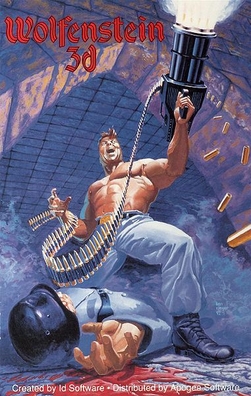
VIDEO GAME REVIEW: Wolfenstein 3D (1992)

Wolfenstein 3D is commonly known around gamer circles as the grandfather of all first-person shooters. I happened to be well-aware of it's existence in my youth when my cousins acquired the shareware version on their Mac, and repetitively got in trouble with my parents for playing it, due to it's ultra-violence. Nearly 20 years later, in 2011, Wolf 3D is pretty tame by today's standards, but it still happens to be a lot of fun. Since it recently resurfaced on the PlayStation Network around the same time that the similarly-themed Inglourious Basterds was released, I found a copy online, and through running a program called "DosBox", managed to get this sick puppy gunning on Windows 7!

You play an American WWII POW, who has been captured by the Wermacht and brought to the infamous stronghold Castle Wolfenstein, in Nazi Germany. The object is to escape by blasting your way through legions of guards, enforcers, and even Der Führer, Hitler, himself! Along the way, you'll find secret areas containing treasure that you can collect for points, and ultimately extra lives, as you find your way to the exit and onto the next level. The game takes place over six episodes, each dealing with an evil plot that your protagonist must overthrow, in order to stop the Nazis.

Wolf 3D has definitely aged, there's no doubt about it. I'm sure many modern gamers may balk at the lack of "hand-holding" that this game does, in contrast to more recent digital fare. But I happen to appreciate it's simplicity; it's a great cooldown game after a long, hard day of dealing with the masses at work. Oh, what a guilty pleasure it is just to come home and plow down evil Nazis with a chaingun for about an hour or so, while my inner-Jew cackles at the morbid irony. The maze-like configuration of the levels can be frustrating at times, but it's surprisingly a great little way to exercise my spatial memory. While I wish there could be a little more variety to the game, it's fun enough to appreciate in it's simplicity.

7/10

Peace,
- Jon

Saturday, February 26, 2011

MOVIE REVIEW: How the West Was Won (1962)

Normally, I'm not one to go leaping at the sight of a western on the movie shelf, but How the West Was Won attracted me for one reason on the box: "Cinerama". What is Cinerama, you may ask? It was, in my opinion, the IMAX of it's day: Basically, take three cameras shooting perpendicularly at 45-degree angles and stitch the three shots together on a tri-paneled, curved, screen - the result was an immersive experience that, according to the documentary on the DVD that I watched, helped bring TV-fixated post-war Americans back into the movie theatres, and gave birth to "Widescreen". You can read more on Cinerama, here.

So when I got around to watching How the West Was Won, I wasn't sure what to anticipate, in terms of presentation. But when presented on my 50" 16x9 LCD, I got something like this:


Now THAT'S wide! I don't think I'd seen actual letterbox on my TV in nearly eight years since we got a widescreen TV. I can only imagine what the film looked like in it's Cinerama heydey...

But onto the film itself - this is more or less so an episodic odyssey of a number of different vignettes somehow tying into the film's namesake of how American colonists carved a name out for themselves in the American west. It's a slice of classic Americana, done in true Hollywood style, and (if I may stand on my soapbox) complete with typical disregard to Native Americans by reducing them to stereotyped "savage" women and children-killers (as if white people didn't do any worse?). The stories are nice, but they're rather featherweight, lacking any realistic dramatic weight. In fact, the whole movie feels more like one of those elaborate travelogue films you go see at Disneyland, only this one at least tries to make an attempt at legitimizing it's Cinerama gimmick by going the distance with production value.

Aside from the story and acting, the overall production is very much impressive. Since I've already harped on the cinematography, I will say there are some nice action pieces, and the attention to detail as well as the attempt to at least drive somewhat of a cohesive narrative through the imagery is admittedly admirable. How the West Was Won is really more of an entertaining museum piece in my eyes, but it's a nice, visually splendid take on how Hollywood once used to run the show with panache.

7/10

Peace,
- Jon